Description
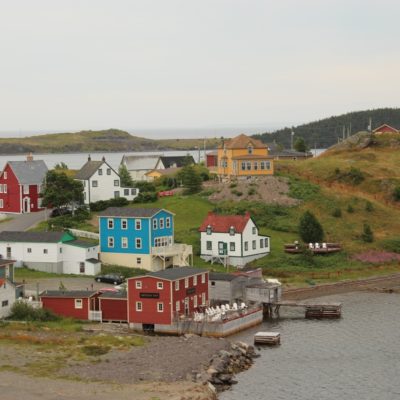
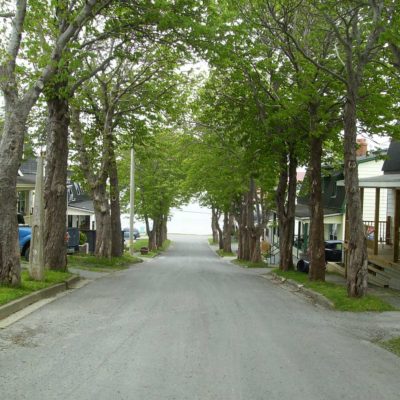
Port Union, NL is a small town on the Bonavista peninsula, beside the Catalina Harbour. Dominated by large, imposing commercial buildings on the harbour to the west, historic Port Union rises from the water up the hillside of a rocky terrain. The historic district includes the section of Port Union located along the Catalina Harbour arranged more or less around a triangle of streets, and about one mile away the hydro-electric station on the Catalina River and its associated canal and dams. The buildings, associated structures and landscape features within the district include salt, fish and retail stores, the Union Electric Building, a factory, garage, post office, train station, church, hotel, Coaker’s residence “the Bungalow”, row housing, the Coaker monument, and a hydro-electric power generating station, among others. The designation applies both to the townsite and to the hydroelectric plant, including the area bounded by the harbour front, Reid Road, Upper Road and including the enclave of Coaker houses above Upper road, as well as the town’s hydroelectric power station (including penstock/flume, take to flume, canal, dam and reservoir).
Statement of Significance
Formal Recognition Type
Municipal Heritage District
Heritage Value
Port Union Municipal Heritage District has been designated a municipal heritage district by the Town of Trinity Bay North due to its historic, social and aesthetic value.
Port Union Municipal Heritage District has historic value due to its association with the Fishermen’s Protective Union (FPU). The town was first conceived by Sir William Ford Coaker, a St. John’s born union activist. Coaker formed the FPU on November 2 and 3, 1908 as a means of empowering fishermen during a time when the truck (credit) system of trade was still prevalent. Under Coaker the union established trading stores, a newspaper, and a political party which fought for social and economic reforms. The location of Port Union was chosen by Coaker after he moved the main FPU office out of St. John’s in an effort to be more centrally localized with the members of the union. In 1916 the FPU headquarters were founded. Designed to house these headquarters, Port Union was an expression of the combined efforts of Coaker and the fishermen and is the only town in Canada founded by a union.
Port Union Municipal Heritage District has social value as it is an outstanding example of a significant social phenomenon: that of the establishment of a union town noted for its commercial success in the face of aggressive competition from commercial merchants in Newfoundland. The community serves as both a symbol and an expression of the Fishermen’s Protective Union and its success at helping sever a centuries-old dependence on Newfoundland merchants. The town of Port Union is the result of union president William Coaker’s vision which was backed financially and politically by union members, most of whom were fishermen.
Port Union Municipal Heritage District has aesthetic value as a virtually intact purpose-built community. The union origins of Port Union are embodied in the site, setting, vernacular architecture and plan, which together convey a strong sense of place and history, still readily identifiable with a minimum of intrusive elements. In 1916, the FPU began constructing buildings along an empty stretch of shoreline. By 1926, they had established premises for its retail, export, shipbuilding and publishing companies. The town also included a large meeting hall, a railway station, a church, and duplexes for workers. A hydro-electric plant, located over a kilometre away, supplied the community. The town’s original layout and many intact buildings speak to its commercial and industrial success during is heyday (1918-1925) as a vibrant international port.
Source: Municipality of Trinity Bay North Regular Council Meeting Motion 2005-08-01-354 August 1, 2005.
Character Defining Elements
All those elements of historic Port Union, in combination with the buildings, structures, landscapes and natural resources of the union-built town, including:
– the informal plan, reflective of the site’s geography, and its bipartite nature with a harbour side area and the hydro-electric plant area;
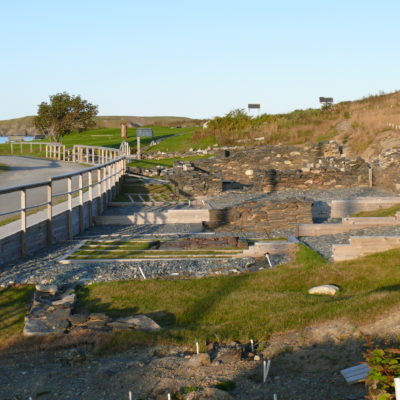
– the single-storey, concrete, gable-roofed hydro-electric plant sited beside the Catalina River, with nearby penstock/flume, intake, canal, dam and reservoir;
– townsite area organized with waterfront grouping of commercial buildings, and moving back from the harbour and up the hill, the former railway station and post office, a collection of houses, Coaker’s former residence, “The Bungalow” with nearby gravesite and monument, and Holy Martyrs Anglican Church;
– the V-shaped layout of townsite streets;
– the full range of buildings and structures necessary to ensure the town’s self-sufficiency;
– the presence of functioning wharves;
– the predominance of wood-frame construction;
– predominant colour palette of yellow, blue and white;
– wood-frame housing (mainly duplexes with a few singles) with wooden cladding, rectilinear two-storey massing under gable roofs, standardized classically inspired design, differentiated to reflect occupant income levels and serviced with water and electricity;
– surviving, locally made wooden doors and window sashes;
– the wood-frame, vernacular Queen Anne Revival style former Coaker residence set within a grassed lot framed by fencing, overlooking the harbor;
– the Gothic Revival-style Holy Martyrs Anglican Church with its twelve commemorative stained glass windows, on its picturesque rocky perch, and;
– the Coaker gravesite with its marble tomb topped by a bronze bust set within a fenced lawn on a hilltop site near the community cemetery.
Location and History
Community
Port Union
Municipality
Town of Trinity Bay North
Construction (circa)
1916 - 1925
Builder
Sir William Ford Coaker
Location
Similar Heritage Properties

 Google map
 Website