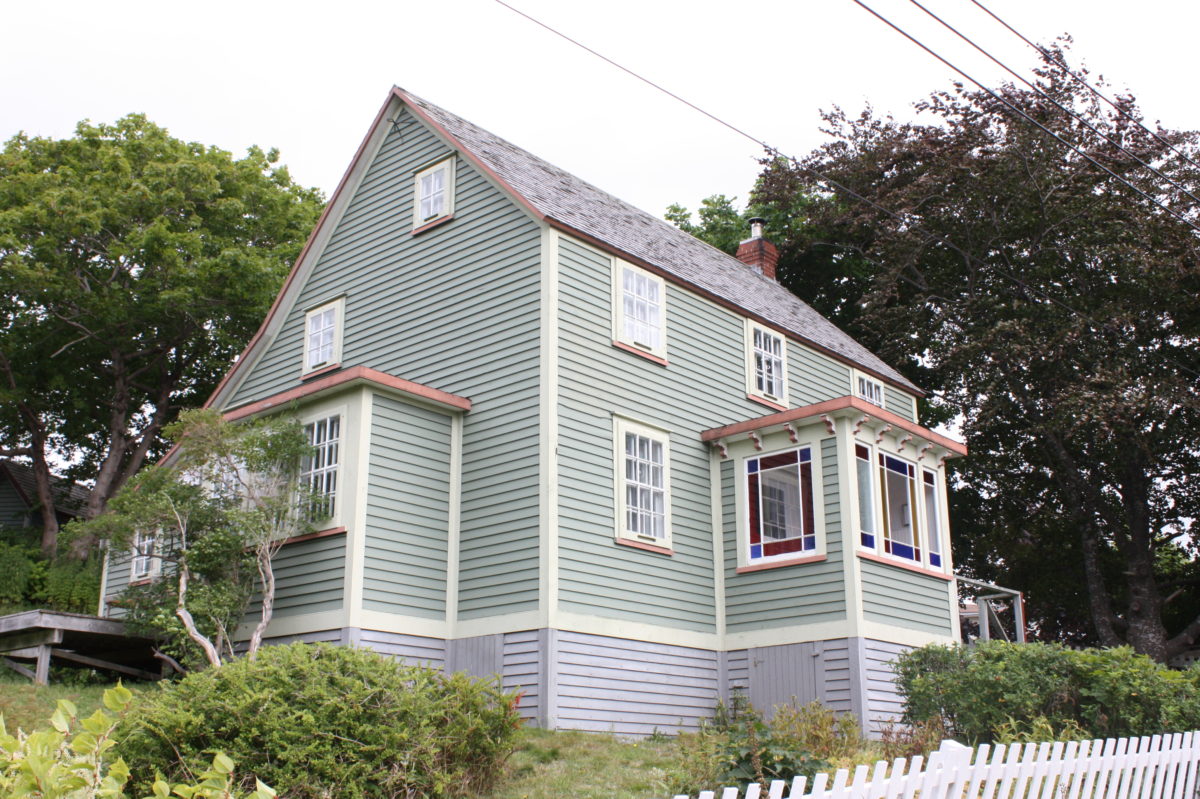
The Randell House is a two-and-a-half storey, saltbox style house located in Port Rexton, NL. The designation is confined to the footprint of the building.
Formal Recognition Type
Registered Heritage Structure
Heritage Value
The Randell House was designated a Registered Heritage Structure by the Heritage Foundation of Newfoundland and Labrador in 1996 because of its historic and aesthetic value.
The Randell House has aesthetic value as an example of saltbox-style construction in the region. Built in 1852, this house was constructed using mortise and tendon stud framing, while the linhay was constructed using balloon framing. The exterior design is simplistic with a symmetrical front façade, reflective of outport construction at the time. John Randell, son of the original owner of the house, made several changes to the interior of the property, including the removal of a stairway and a large central fireplace. On the exterior, he added a front porch, complete with stained glass windows. In the following years, after the house became the property of Mary Patience, a bay window was added to the front of the house. Decorative eave brackets were added along the roofline of the bay window, adding to the visual appeal of the front façade.
The Randell House has historic value because of the prominent figures associated with it. Captain Isaac Robert Randell, son of the second John Randell, was born in this house in 1871. In his lifetime, he was the master of a number of ships and led several Arctic voyages for the Canadian government. He also served two terms as a member of the House of Assembly and was appointed to the Legislative Council in 1931. Another prominent citizen, Mary Patience, the sister of Captain Isaac Robert Randell, lived in this house for many years. Mary and her brother Egbert Randell inherited the house after their parents’ deaths. During the First World War, Mary served as a nurse and later worked as a teacher upon her return to Newfoundland. The local post and telegraph office in Port Rexton was originally located on the road near the Randell house, but after the government decided to cease the post office’s operations, Mary Patience had the office moved to behind Randell house to prevent the building from being demolished.
After Mary Patience’s death in 1956, the house was uninhabited until 1995, when it was purchased by Florence Severs, who repaired the serious damage from four decades of disuse and restored the house back to its former condition. In 2000, the Newfoundland Historic Trust awarded Florence Severs the Southcott Award for Restoration for her work in preserving and restoring the property.
Source: Heritage Foundation of Newfoundland and Labrador property file “ Port Rexton – Randell House – FPT 1608”
Character Defining Elements
All elements that define the building’s saltbox design including:
-saltbox roof;
-symmetrical facade;
-window placement;
-porch and bay window additions;
-narrow clapboard;
-wooden shingles on roof;
-original windows and doors;
-stain glass windows in porch;
-simplicity of exterior detailing; and,
-location within the town, unimpeded view of town.
 Google map