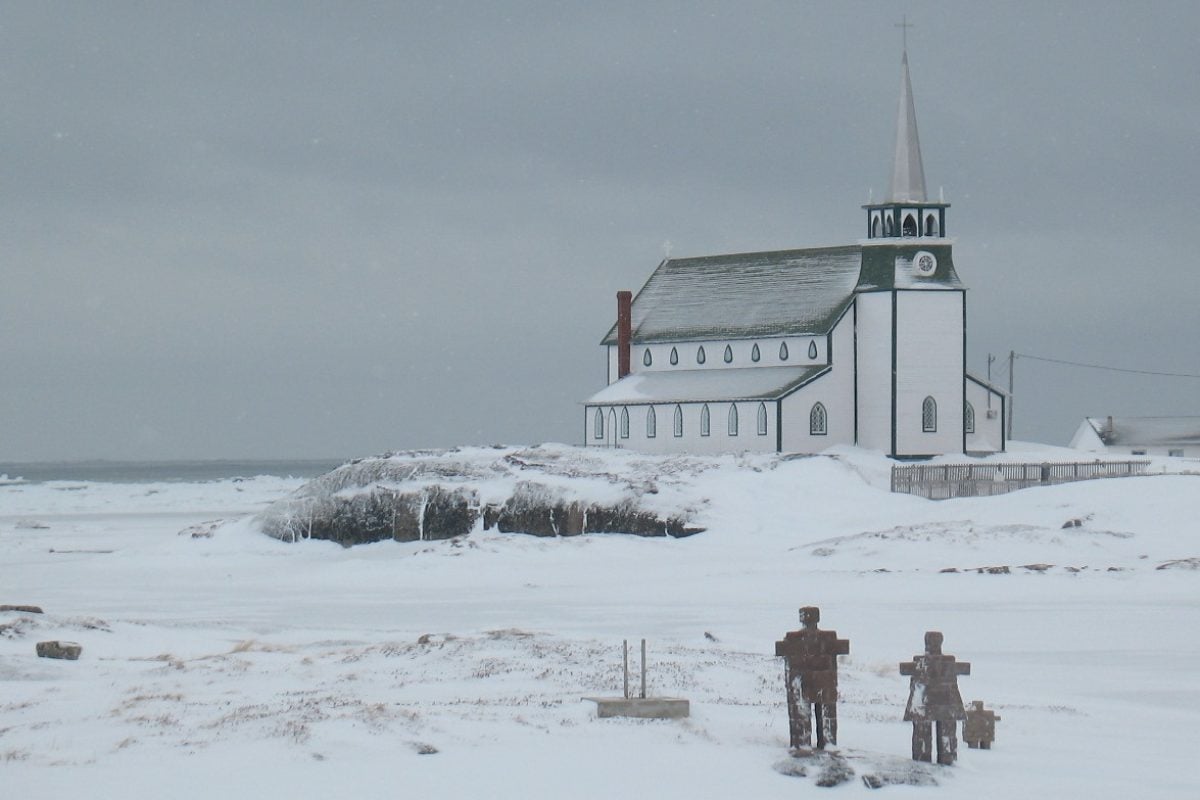
St. Luke’s Anglican Church is a wooden, vernacular Gothic Revival church located on a point of land called Burnt Island overlooking Sloop’s Run Tickle in Newtown, NL. The designation is confined to the footprint of the building.
Formal Recognition Type
Registered Heritage Structure
Heritage Value
St. Luke’s Anglican Church was designated a Registered Heritage Structure by the Heritage Foundation of Newfoundland and Labrador in 2012 due to its aesthetic and historic value.
St. Luke’s Anglican Church has aesthetic value due to its style, craftsmanship and environmental setting. It is an excellent example of a Gothic Revival church in an outport setting and stands as a testament to the quality of the craftsmanship of the period. In keeping with the Ecclesiological tradition of the time, the western silhouette of the church is a pyramidal shape, formed at the base by the aisle wings, narrowing at the clerestory walls and forming a peak through the central tower. The chancel is denoted on the exterior by the end of the aisle wings and the use of taller arched windows. Other Gothic features include the steeply pitched gable roof, Celtic cross on the eastern gable end, intricate multi-paned pointed arch windows, pointed arch doors, elliptical triangle windows in the clerestory and a large bell tower with a spire and finials.
Adding to the aesthetic value of St. Luke’s Anglican Church is its picturesque environmental setting. Located on one of the many small islands that make up the community of Newtown, it is a prominent landmark and can be easily recognized from many vantage points. For generations it has also served as a navigational aid for fishermen in the area.
St. Luke’s Anglican Church has historic value due to its age and because it is a physical testament to a way of life once common in small communities throughout Newfoundland and Labrador. Construction of the church began in 1892. A smaller school-chapel built in 1881 had been previously used but it was too small for the needs of the congregation. The Church of England ladies’ group set about raising some of the needed monies. Sealing captains also raised money onboard their vessels. Those who could not give monetary donations gave building materials and salt fish.
The cornerstone for the new church was laid on December 29, 1892 and the foundation was started the following spring. Building foreman Thomas Granger of Port Union was the only professional builder to work on the church. He supervised the men of the community who voluntarily worked in “gangs” – each gang working one week at a time. These men were mostly fishermen and, because of the seasonal round of work at the time, they could only work on the church in late winter before the seal hunt started and in the late spring before the cod fishery began. This only allowed a few months each year to devote to construction. Mr. Granger also carved the altar of the new church. The interior finishing work was completed by Mr. Robert Ryder of Bonavista. The church was consecrated by Bishop Llewellyn Jones on August 7, 1895 (a confirmation service was held the same day) and the church was completed in 1900. Such community efforts to erect public buildings were once a common practice in small communities. These projects speak to an earlier way of life which is waning in the face of centralized religious governance and regional concentration of places of worship.
St. Luke’s Anglican Church has further historic value due to events associated with the church. One very significant event occurred in the church while it was still under construction. In March of 1898 the sealing vessel S.S. Greenland became stuck in the ice during a ferocious storm and failed to pick up many of its crew members from the ice. These men were left on the ice to face the elements until the boat was freed from the ice the following day. Forty-eight sealers perished on the ice and only twenty-five bodies were recovered. Of the men who died, almost half were from towns in the Newtown area. A memorial service was held at St. Luke’s to honour the sealers who perished in what became known as “The Greenland Disaster.”
Source: Heritage Foundation of Newfoundland and Labrador property file “Newtown – St. Luke’s Anglican Church – FPT 3384”
Character Defining Elements
All those features that represent the Gothic Revival style of the building, including:
-height of structure (including tower with spire);
-steeply pitched gable roof;
-bell tower with mansard roof, round window, arched openings, finials and spire topped with a cross;
-Celtic cross finial on the eastern gable peak;
-rounded exposed beams under the eaves;
-chimney style and placement;
-narrow wooden clapboard;
-wooden corner boards;
-pointed arch wooden window size, style, trim and placement;
-size, style, trim and placement of elliptical triangle wooden windows in the clerestory;
-size, style, trim and placement of round wooden window in the eastern gable;
-size, style, trim and placement of exterior wooden doors, and;
-location, orientation, and dimensions of building.
 Google map