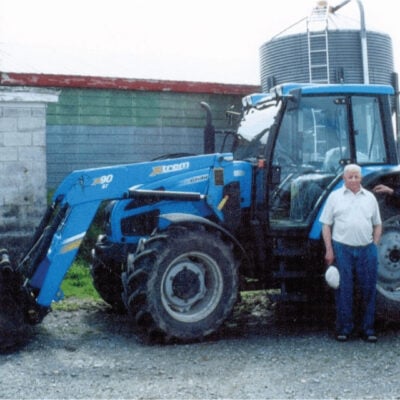

Description
NOTE: In 2005 the Agricultural History Society of Newfoundland and Labrador created the “Century Farm Award” to honour farm families across the province who had farmed their land continuously for one hundred years or more and were still actively farming. Heritage NL agreed to post these listings on our website. Please note that these farms are NOT designated by Heritage NL. The listings are commemorative only. All content and images © Agricultural History Society of Newfoundland and Labrador and used with the permission of award recipients.
Information below was current as of 2006-2007.
The MacInnis Farm
The MacInnis farm in Highlands has been in the MacInnis family for many generations. The farm was settled by Alexander MacInnis in 1850 and the land grant dates from 1890. The farm has been passed down through the family: Alexander MacInnis 1850-1864, John MacInnis 1864-1895, James MacInnis 1895-1930, Edward Joseph MacInnis 1930-1962, Donald MacInnis 1962-1980 and since then Donald and Edward and Elin MacInnis.
From its early days, the MacInnis farm flourished. During its first century, the farm produced a range of products: potatoes, cabbage, turnips, carrots, beets, barley, corn, milk, butter, beef, pork, lamb. But after the death of Alexander’s great grandson Edward in 1962, the farm became more specialized. Vegetables were grown in rotation with hay and corn. Today, production includes cabbage, rutabaga, tomatoes, beets, honey and hay.
This Century Farm has a family story about involvement with an incident at sea. A wooden sailing ship, the ARRAN, left Greenock, Scotland on April, 7th, 1868, with a cargo of coal, bound for Quebec. Once out to sea, stowaways were discovered on board: 2 boys age 11, 2 boys age 12, 2 boys age 16, and one fellow in his early twenties. There seemed to be no particular connection among these individuals. The boys were made to work on board ship, and given less than adequate rations. Starving, the boys were accused of every theft of food on the ship, and were flogged for it.
On May 9th, the ARRAN became trapped in the ice in St George’s Bay. The master and the mate went over the side to investigate the situation, and the boys took their chance to steal some food. They were caught and flogged and food was withheld from them. On May 15th, with the exception of one twelve year old who was known to the mate, the stowaways were put over the side and told to walk to a ship nearby. But the boys could not see the ship in the mist and headed for shore – a distance reckoned to be between six and fifteen miles. Starving, inadequately clothed, one boy with bare feet. Two of the younger boys died on the ice. The others were seen from shore, across a gap of open water, and boats were sent out to rescue them. They were given shelter by a fisherman-farmer called MacInnis and nursed back to health by his wife. Meanwhile, the next day, the ice broke up and the ARRAN proceeded to Quebec.
However, one member of the crew informed the authorities of what had taken place. Justice sought out the Captain and the mate. The stowaways were called upon to bear witness and those guilty were sentenced to prison terms. None of the survivors looked for a life at sea.*
* “Stowaways of the “Arran” in George Blake, Down to the Sea, Houghton Mifflin Company, 1937, pp.266-286.
The Agricultural History Society of Newfoundland and Labrador is mandated to collect and honour the history of agriculture in this province and to raise public awareness of agriculture as a theme in the story of the province. In 2005 the Society created the Century Farm Award which is meant to identify, recognize and honour any farm family who have continuously farmed the same land for one hundred years or more and who continue to farm it at the present time. This award represents the pioneering agricultural history of the province: some farms supplied the growing town of St. John’s with milk, produce, meat and forage for livery stables; other farms supplied vegetables and butter to fishing communities by coastal boat; and others sent produce and dressed poultry by rail to the new resource towns, such as Grand Falls. Some of the early farmers came directly from the British Isles and others came to Newfoundland from earlier settlements in Nova Scotia. From their early beginnings these farms have survived as productive agricultural businesses by adapting successfully to changing market demands and changing economic circumstances and by adopting innovative technology. They have kept their land in good heart through as many as half a dozen generations. The Century Farm families have earned the Century Farm Award in recognition for their contribution to the history of our province and for their commitment to agriculture in the province’s future.