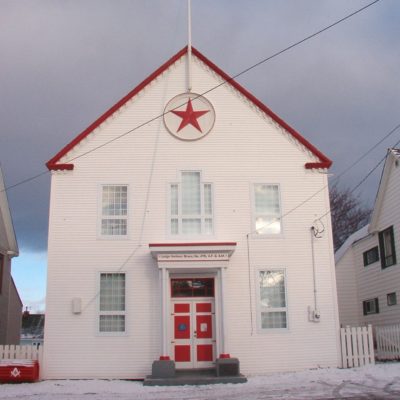
The Ashbourne Longhouse is a two-storey structure with a mid-pitch roof. Constructed sometime between the late 1700s and early 1800s, this Georgian inspired home is located on Main Street in Twillingate, NL. The designation is confined to the footprint of the building.
Formal Recognition Type
Municipal Heritage Building, Structure or Land
Heritage Value
The Ashbourne Longhouse has been designated a municipal heritage site by the Town of Twillingate due to its aesthetic, historic and cultural values.
Ashbourne Longhouse has aesthetic value as it is a good example of Georgian inspired merchant class housing. In addition, the longhouse style of construction is very rare in the province. The physical grandness of the house is tempered by the symmetrical facade lacking in decorative features, which creates a sense of order and simplicity. Its scale was apparently achieved through additions to a much smaller residence. Physical evidence uncovered during restoration revealed another roof under the present one. This roof would have topped a structure measuring 7.62 m X 7.62 m.
Ashbourne Longhouse has historic value as it is one of the oldest surviving private residences in Twillingate and the province. Constructed in the early 1800s, it was owned by a series of individuals who were influential in the economic and political evolution of the region. William Menchinton, the first owner of the property, operated a large mercantile establishment in Twillingate and made a great contribution to the local economy and to the development of fisheries in the region. Edwin Duder Sr., the owner of a large mercantile firm in St. John’s, purchased Menchinton’s premises in Twillingate. His company was very successful and his presence in Twillingate speaks to the community’s significant role in the fishing industry of the time. William Ashbourne, a prominent merchant in Twillingate, bought the house in 1897. Ashbourne outfitted schooners participating in the Labrador fishery and the seal hunt, as well as exporting fish and seal products, contributing to the economic growth of Twillingate. William’s son Thomas played an important role in Newfoundland’s political evolution. He became a member of the House of Assembly in the 1920s, was a pro-confederate delegate to the National Convention from 1946-48, helped determine the Terms of Union for Newfoundland’s confederation with Canada, and post-confederation Ashbourne became a member of the federal House of Commons.
Ashbourne Longhouse has cultural value as it is representative of a particular time and place. In a community context it is a physical reminder of the prosperity of businesses involved in the fishery and related industries throughout the nineteenth and early twentieth century.
Source: Town of Twillingate Regular Council Meeting Motion 07-205 November 5, 2007.
Character Defining Elements
All those elements which represent the aesthetic, historical and cultural value of Ashbourne Longhouse, including:
-symmetrical Georgian facade;
-mid-pitch roof;
-number of storeys;
-wooden roof shingles;
-narrow clapboard;
-corner boards;
-window size, style, trim and placement;
-size, style, trim and placement of exterior doors;
-size, style and placement of three chimneys;
-wood post foundation;
-dimension, location and orientation of building, and;
-association with developing fishing industry in area.

 Google map
 Town of Twillingate website