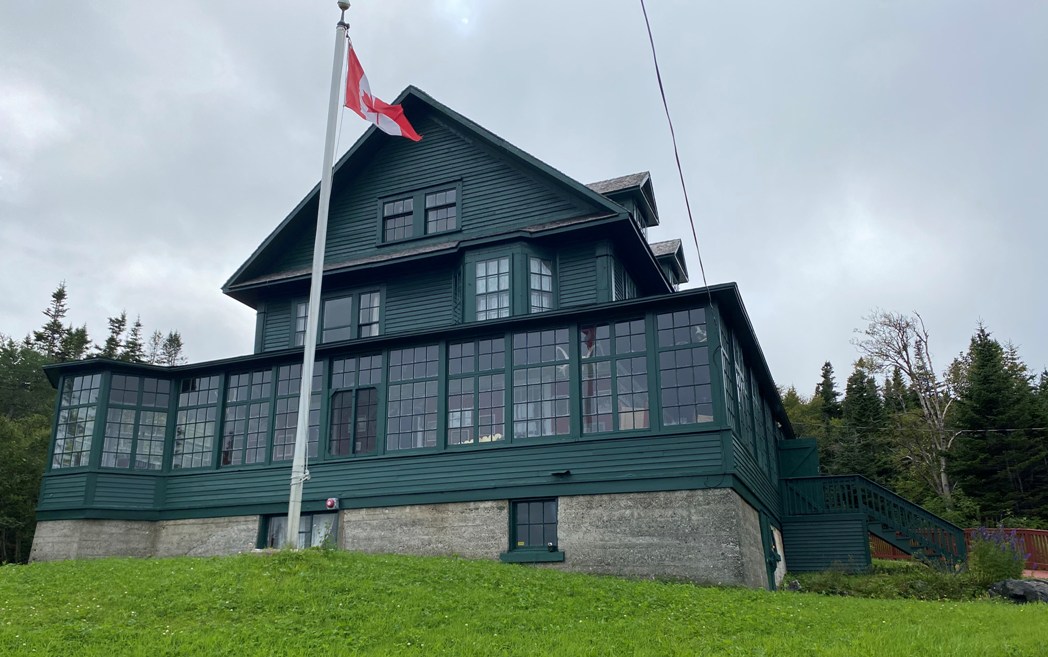
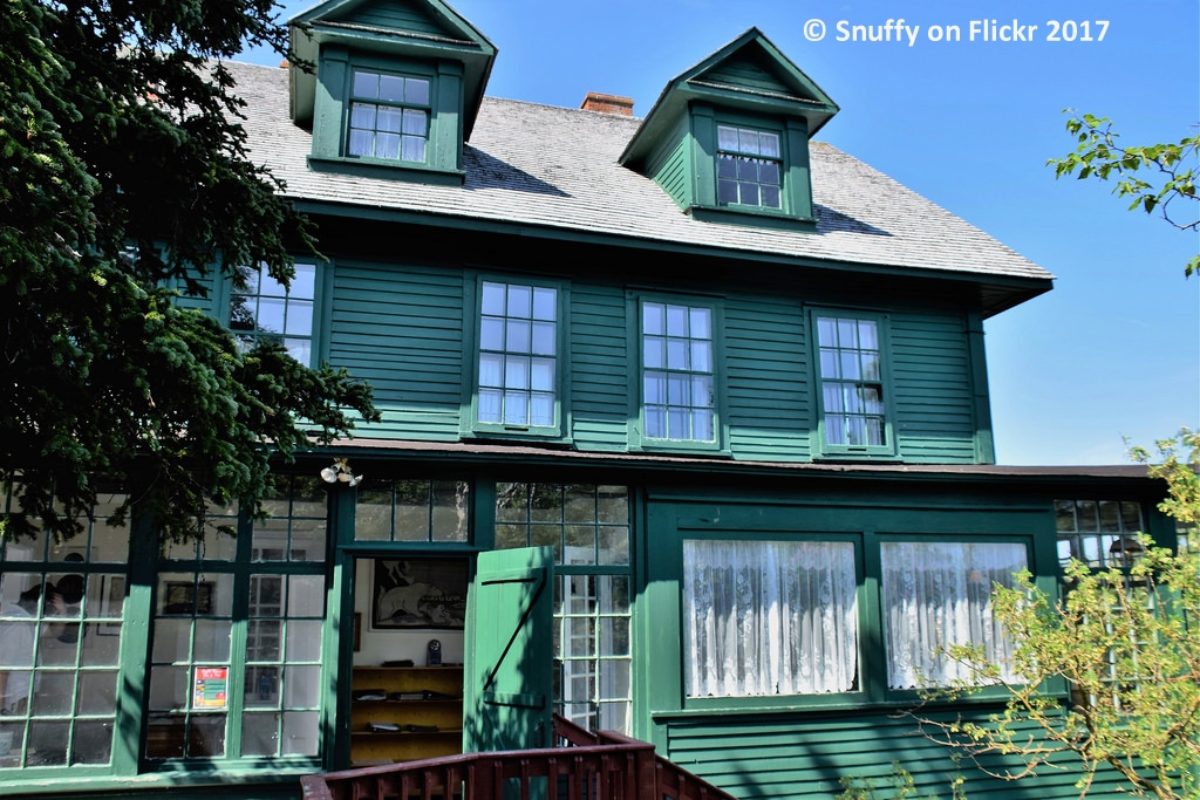
Grenfell House is a two-and-a-half storey, wooden house with a steeply pitched roof. It is located on a hill overlooking the town of St. Anthony, NL. The designation is confined to the footprint of the house.
Formal Recognition Type
Registered Heritage Structure
Heritage Value
Grenfell House was designated a Registered Heritage Structure by the Heritage Foundation of Newfoundland and Labrador in 1986 due to its historic and aesthetic value.
Grenfell House was built in 1909-1910 as the residence for Dr. Wilfred Grenfell and his family. Grenfell was a noted missionary and philanthropist who first came to Newfoundland in 1892 as a part of the Royal National Mission to Deep Sea Fishermen (RNMDSF) to investigate the living conditions associated with the Labrador fishery. During his travels, Grenfell was shocked by the poverty and lack of healthcare he encountered in northern Newfoundland and the Labrador Straits. He returned the following year with a team of two doctors and two nurses. Aided by the Newfoundland government, Grenfell established the first hospital on the Labrador coast at Battle Harbour. Grenfell believed that many of the problems he saw stemmed from the fishermen’s economic dependence on the merchants. Consequently, in 1893 he helped form a fisherman’s co-operative at Red Bay. By 1909, there were eight such co-operatives in operation. Grenfell also established a cottage craft industry in 1906, encouraging women to sell hooked mats to pay medical expenses or earn extra money for their families.
In 1909, Grenfell opened Newfoundland’s first inter-denominational school and supervised the building of Grenfell House, where he then lived in the wintertime with his wife and three children. The summer months were spent on fundraising and recruitment tours in England, Canada and the United States. By 1912, Grenfell had left the RNMDSF and established the International Grenfell Association (IGA) with its headquarters in the United States. Grenfell House was then modified to become a staff house and a dormitory for the IGA. By the time of Grenfell’s retirement in 1935, the IGA had established five hospitals, seven nursing stations and three orphanages in the region. Grenfell House continued to house IGA workers until 1978, when the house was donated to the Grenfell Historical Society. It has operated as a community museum since 1981, and is a reminder both of Grenfell’s influence in the region and of the impacts of IGA institutions in northern Newfoundland and on the Labrador coast.
Grenfell House, built by local carpenters, was designed by the Grenfells themselves and has several features that separate it from the vernacular architecture of fishermen’s houses at the period. The sunroom that follows the entire front façade, though unheard of in local housing, was not uncommon for early hospital construction, as sunshine was thought to have healing properties. The sunroom is a good example of how Grenfell’s attitudes towards medicine and well-being carried over into his own home. Grenfell House was equipped with a coal furnace, steam heat, plumbing fixtures and electricity – the height of modernity in early twentieth-century St. Anthony. These technologies, along with the size, style and hilltop location of this house known locally as “The Castle on the Hill,” reflect the social prominence of Grenfell and his family.
Source: Heritage Foundation of Newfoundland and Labrador property file “St. Anthony – Grenfell House – FPT 1617”
Character Defining Elements
All elements that are representative of the building’s New England Cottage design including:
-number of storeys;
-steep gable roof;
-chimney number, style and placement;
-narrow wooden clapboard;
-wooden corner boards;
-size, style, trim and placement of wooden windows and wooden storm windows;
-dormer size, style, trim and placement;
-dormer window size, style, trim and placement;
-size, style, trim and placement of exterior wooden doors;
-wooden transom windows on doors;
-size, location and style of sunroom;
-hilltop location, surrounded by flowers and mature trees, and;
-dimension, location and orientation of building.
 Google map
 Grenfell Historic Properties Website