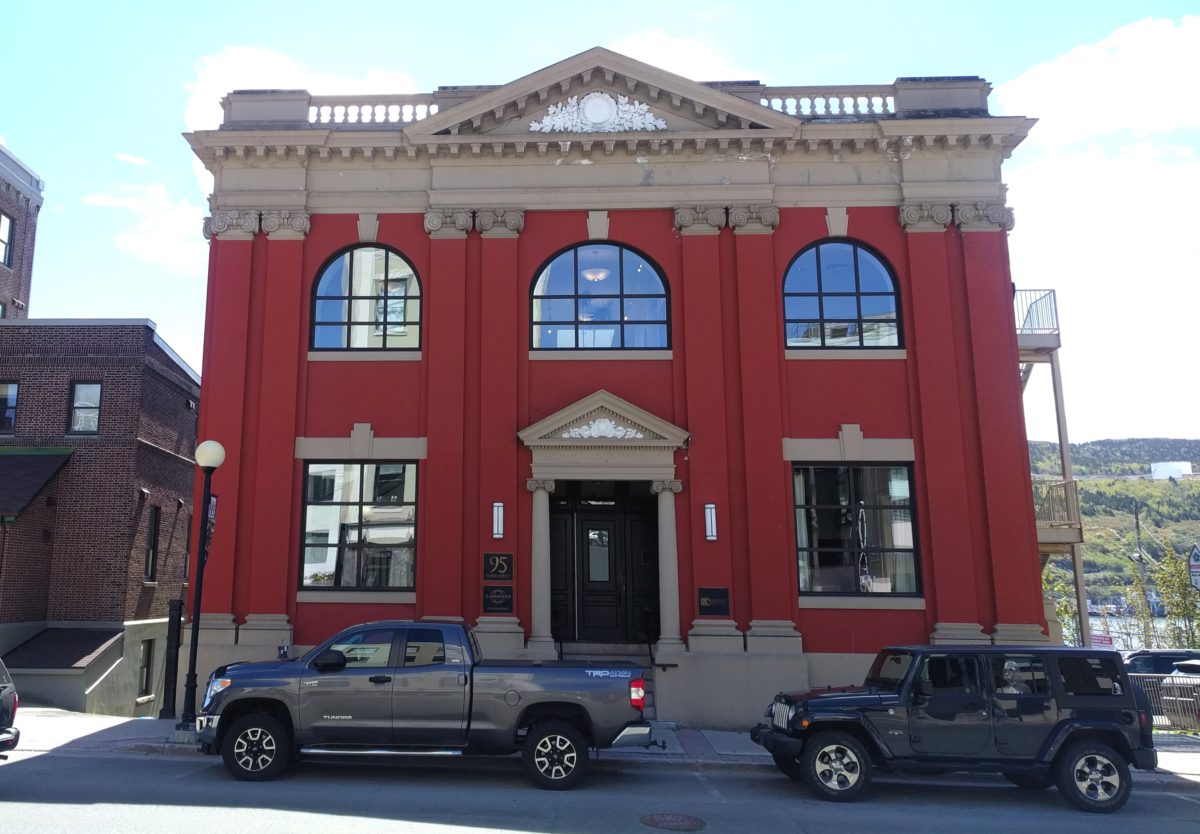
The Commercial Cable Company Building is a two-storey Classical Revival style structure located at 95 Water Street, St. John’s. The designation is confined to the footprint of the building.
Formal Recognition Type
City of St. John's Heritage Building, Structure, Land or Area
Heritage Value
The Commercial Cable Company Building has been designated a Municipal Heritage Building by the City of St. John’s because of its historical and architectural values.
Commercial Cable Company Building is of historical significant because of its associations with a prominent Newfoundland based company and, additionally, it is valued for its links to noted figures in Newfoundland’s history. It was constructed in 1915 for the Commercial Cable Company, one of Newfoundland’s main telegraph companies at the time. As a result of the declining need for telegraph lines, the Commercial Cable Company ceased operations in 1961 and the center was sold to John C. Doyle. Doyle, an American business man, came to Newfoundland to develop the vast iron ore resources in Western Labrador. He is considered to be one of the most instrumental figures in the development of Labrador’s iron ore, even though his career in Newfoundland was filled with controversies and lawsuits. Following Doyle, the Christian Brothers purchased the center and turned it in to a trade school for persons unsuccessful in completing high school.
Architecturally, the Commercial Cable Company Building is highly distinguishable due to the fact that it is one of few remaining Classical buildings left in downtown St. John’s today. The building was designed by noted architect William F. Butler, who is best known for his lavish residential buildings throughout St. John’s. It features a strongly detailed classical facade with a paired pilaster and ionic capitals, a deep bracketed cornice and a pediment containing a folk-like cartouche. It is similar to the Royal Bank on Water Street in St. John’s, but the detail with this building is more ornate. Made primarily of concrete, stone, steel and brick, this buildings is almost entirely fire proof, a valuable feature considering the histories of fires in downtown St. John’s.
Source: City of St. John’s, meeting held 1989/07/21
Character Defining Elements
All original features which relate to the age and construction of the building, and those features typical of the Classical Revival style including:
-flat roof, cartouche located on front façade, pilasters along all sides of building, ionic capitals, masonry exterior;
-ornate decoration along eaves of building;
-original balustrade;
-arched windows along upper level, rectangular windows along lower level;
-decorative stonework and sills around windows;
-decorative pediment and lettering above doorway;
-pair of pillars with ionic capitals located on the main entrance, and;
-orientation of main entrance with respect to Water Street and other buildings.
Notes
This is one of the last remaining Classical stuctures left in St. John’s.
 Google map
 Website