Description
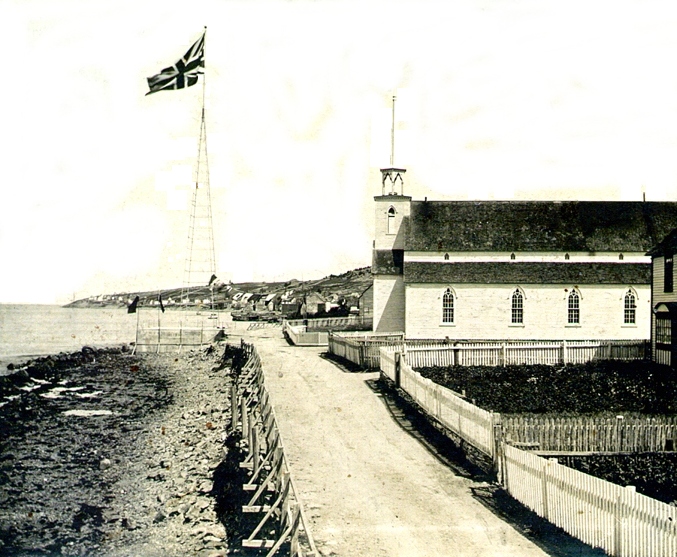
The John Guy Flag Site is located off the main road and at the water’s edge, within the town of Cupids, NL. It is comprised of a 26 metre flagstaff with a very large Union Jack flag, and sometimes flies a very large Canadian flag. The designation is confined to the small, paved area set back from the road which is used exclusively for the flag pole and flags, and which contains a brass commemorative plaque and public seating.
Statement of Significance
Formal Recognition Type
Municipal Heritage Building, Structure or Land
Heritage Value
The John Guy Flag Site has been designated a municipal heritage site by the Town of Cupids for its historic and cultural value.
The John Guy Flag Site has historic value for its age. The site was first built in 1910 with a 41 metre steel flagstaff to fly the Union Jack flag on the occasion of the 300th anniversary of Cupids . The original flag, sized 7 metres by 11 metres, is on display in the community museum. The site was restored by the Cupids Historical Society in 1983 for the Sir Humphrey Gilbert 400th anniversary. Today it houses a 26 metre pole made of southern yellow pine from Alabama, reaching 22 metres above ground. The pole flies a giant Union Jack flag which measures 7 metres by 14 metres; at the time it was presented it was one of the largest Union Jacks in the British Empire. On special occasions a giant Canada flag is also flown. A brass commemorative plaque was erected on the site in 1985 to celebrate Cupids’ 375th anniversary as the first official English settlement.
The John Guy Flag Site is also historically valuable for its associations with John Guy, a 16th-century Bristol merchant. Cupids was the first English colony settled in Canada in 1610, and the second in North America, following Jamestown in Virginia, USA (1607). The colony was led by newly appointed Governor John Guy, who brought approximately 39 settlers and supplies to start a British colony in the new world. They were instructed to fortify the settlement at Cupids (then known as Cuper’s Cove) in Conception Bay, experiment with farming, cut spars and planks, make salt, potash and glass, collect samples of ore and, significantly, to fish and trade in cured fish and train oil (from whale blubber). The John Guy Flag Site commemorates this historical achievement by flying the Union Jack as a salute to Britain and John Guy.
The John Guy Flag Site has cultural value because it is a reminder to the residents of and visitors to Cupids that the community was first settled by Europeans in 1610 and that it is the ancestor of later settlements. The flag, which when flying can be seen from most vantages in the town, is a visual clue of this historic place and its watershed beginning.
Source: Town of Cupids Council Meeting Motion 031-2007 April 3, 2007.
Character Defining Elements
All those features of the civic space that commemorate the watershed settlement of the town, including:
– 26 metre flagstaff constructed of southern yellow pine;
– giant Union Jack flag which flies from the flagstaff, and;
– brass commemorative plaque erected in 1985.
Notes
The plaque reads: “Cupids 1610-1985 / This plaque was unveiled by His Honour Lieut. Governor W. Anthony Paddon C.M. M.D. on August 24, 1985 / To commemorate the 375th anniversary of Cupids, the first official settlement in Newfoundland. On this site in 1910 to commemorate the 300th anniversary of Cupids a flagpole was erected to fly the largest Union Jack in the British Empire. The original flag (22×36) has been retired and a replacement flag (23×46) flies here on holidays and special occasions / Flagpole and site restoration a project of: the Cupids Historical Society / the Town of Cupids / the General Public.
Location and History
Community
Cupids
Municipality
Town of Cupids
Civic Address
Seaforest Drive
Construction (circa)
1910 - 1910
Location
Similar Heritage Properties

 Google map
 Website