 Google map
 Heritage NL Fieldnote #25 – The Newman Family, Company, and Building
Description
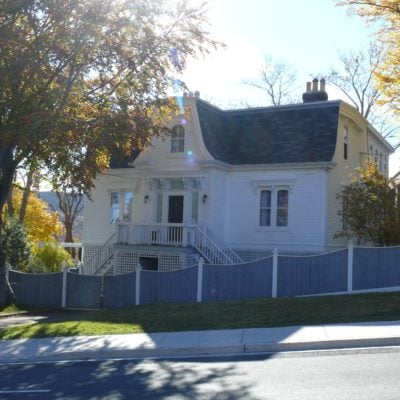
The Newman Building is a two and one half storey 19th century Georgian Revival style office building located at 1 Springdale Street, St. John’s. This building is associated with and located next to the Historic Newman Wine Vaults on Water Street. The designation is confined to the footprint of the building.
Statement of Significance
Formal Recognition Type
City of St. John's Heritage Building, Structure, Land or Area
Heritage Value
The Newman Building is designated a municipal heritage site by the City of St. John’s for its historical and architectural values.
The Newman Building is historically valuable for several reasons. The present Newman Building was constructed in 1848, though another Newman premises sat on the site and survived the Great Fire of 1846. The building is associated with the Newman family and their companies and the building is named for them. The Newman family were merchants from Dartmouth who, in the fourteenth century established themselves in the import and export trade, chiefly in cloth and wool though the firm purchased everything from train oil to seal skins and supplied everything from wine to a fire engine. By 1503 Thomas Newman was importing wines by exchanging fish and salt. Thus began the Newfoundland fish trade relationship with the Newman family. By the seventeenth century, John Newman controlled the whole process of catching and marketing the fish. By the middle of the fifteenth century the Newman family and the fishery were inseparable. The Newman Building was home to this, one of the oldest England-Newfoundland merchant firms which engaged in trade with the world from this site. In the autumn of 1679, a vessel from Portugal laden with port wine and sailing for London was sighted by French privateers. In the attempt to outrun the pursuers, the vessel was driven off course, damaged by storms, and subsequently put into St. John’s for the winter. In the spring when the ship arrived back in London it was found that the cool dampness of the winter in St. John’s, and the voyages out and back had added very pleasant new dimensions to the wine. Until the late 1990s the Newman’s sent their port to Newfoundland for ageing. The provincially designated wine vaults are located next to the building, on Water Street. The Newman Building was the home and offices of the business and it became the residence of the company agent, Mr. Morry.
The Newman Building is also historically valuable because of its numerous tenants following the Newman Company. It was the home of Lewis Tessier, a partner with his brother, Peter, in the large merchant firm of Tessiers, a fishery supply business in St. John’s. Both brothers became involved in politics, and Lewis represented St. John’s West in the House of Assembly for some years. The Newman Building was the home of Henry E. Hayward, a local wholesaler and retailer of wines and spirits during the late 19th century. It was a club house for the West End Club at the turn of the twentieth century. It housed the offices of The Plaindealer, a small local newspaper that once printed articles written by William F. Coaker, before he formed the Fisherman’s Protective Union (FPU), and Joey Smallwood, former Premier and the last Father of Confederation. This building was also the home of The Press Club, a local drinking establishment formed in the early 1950s. It was open to all employees of newspapers, magazines, radio and television in public affairs. The Newman Building is currently owned by the provincial government and it houses the offices of the Arts Council of Newfoundland and Labrador, and the Heritage Foundation of Newfoundland and Labrador.
The Newman Building is aesthetically valuable because it is a good example of 19th century vernacular Georgian Revival style. This building has a symmetrical façade, with five bay openings. The windows are 2/2 and have a small sill on the second floor and a heavier shaped trim on the main floor. The main entrance has a classical pediment with small columns supporting it. The steeply pitched gable roof has a single chimney cut through the ridge. Parged in concrete, this building is otherwise devoid of decoration, and stands as a testament to the time and purpose for which it was built.
Source: Heritage Foundation of Newfoundland and Labrador, 1 Springdale Street, P.O. Box 5171, St. John’s, NL, A1C 5V5
Character Defining Elements
All those elements that embody the 19th century vernacular Georgian Revival style, including:
-steeply pitched gable roof;
-chimney cut through the ridge;
-2/2 windows
-size, style and fenestration of windows
-five bay façade;
-classical pediment with small columns;
-concrete parging, and;
-location and proximity to historic Newman Wine Vaults.
Notes
The following is a brief history of some of the tenants. If you have information to fill in any of the gaps, please e-mail us. Newman & Company (1848-1882) The Newman family were merchants from Dartmouth where in the fourteenth century had established themselves in the import and export trade, chiefly in cloth and wool though the firm purchased everything from train oil to seal skins and supplied everything from wine to a fire engine. By 1503, Thomas Newman was importing wines by exchanging fish and salt. Thus began the Newfoundland fish trade relationship with the Newman family. By the seventeenth century, John Newman controlled the whole process of catching and marketing fish. By the middle of the fifteenth century, the Newman family and the fishery were inseparable. Marketing connections were made with Portugal, the largest consumer of salted cod, and in Spain. Seasonal fishing stations or plantations had been set up in Pushthrough, Harbour Breton, Gaultois and Hermitage. The firm also traded with the planters and Micmac of the south coast and carried on whaling and sealing expeditions to Greenland from Newfoundland. Newman and Company’s practice of sending shipments of port wine to Newfoundland to mature began during the latter half of the seventeenth century when in 1679 one of their ships left Oporto bound for London with a shipment of port. When the ship carrying the Portuguese port was chased by a French vessel and blown off course, the captain then made way for Newman’s Plantation on the Island where the ship waited out the winter. When the wine was later sampled, the contents were found to be further improved. It was deduced that the rolling motion of the Atlantic voyage and something in the air, or climate of Newfoundland had matured the wine, giving it a special character and a high degree of perfection. In 1847, wine vaults were built on the corner of Springdale and Water streets. The wine which was shipped from Newfoundland to England became very popular as a high quality wine in English pubs and amongst the aristocracy. The Newman’s practice of sending large quantities of port to Newfoundland for maturing developed a busy trade between Oporto, St. John’s and London. By the 1850s, offices of the Newman & Company were at Burgeo, Gaultois and Harbour Breton were handling the fish trade, while the St. John’s office operated the wine business. But the Company was experiencing increasing problems with its Newfoundland business. In the 1850s, it became increasingly concerned about the quality of the salt fish it was trading and the competition from St. John’s based firms posed a problem as they became more involved in the outport trade. In 1864, the small Burgeo operation was closed. The larger Gaultois operation was sold in 1900 and in 1907, the Harbour Breton branch was sold – ending over 300 years of Newman’s involvement in the salt fish trade. Lewis Tessier (1882-1892) Lewis Tessier was one of two brothers from Newton Abbott, England who became the biggest exporter of Newfoundland salt cod for some time. Lewis and his brother, Peter came to the island in 1842. The brothers entered into a brief partnership with merchant Samuel Langley, which dissolved in 1847. That same year, the firm of P. & L. Tessier was formed as a fishery supply business in St. John’s. In the beginning, the company was modest; but after 1850, the Tessier brothers became heavily involved in the salt cod trade. By the 1870s, P. & L. Tessier had established itself as one of the largest supply and export firms in Newfoundland. Lewis and Peter both became involved in politics, possibly due to the influence of Peter’s father-in-law, Robert Carter. Lewis represented St. John’s West in the House of Assembly for some years. He won the seat in a by-election in the district where he ran as an Anti-confederate supporting Charles J.F. Bennett. Henry E. Hayward (1892-1894) A local wholesale/retailer of wines and spirits, Henry E. Hayward resided at 1 Springdale Street for a short time. Hayward & Company which was located at 73 Water Street, boasted of wines and spirits which were the best and purest obtainable. West End Club (1894-1900) Very little can be found on this club which was housed at 1 Springdale Street. However, its namesake is still used today by a pub here in the west end of the city of St. John’s. The Plaindealer(1915-1921) The Plaindealer was owned by W.J. O’Neill, and though years of publication are not known, we do know that both Coaker and Smallwood published articles in the Plaindealer before the forming of the Fishermen’s Protective Union. While Coaker’s involvement would suggest to researchers that the Plaindealer may have been political paper, the surviving copy does not reflect this, giving us strong indication why Coaker sought a venue of his own (Fisherman’s Advocate). The only surviving copy of The Plaindealer is a special Easter issue of 1915 which contains poetry, sentimental short stories and incidental news items for the foreign press. While the 1915 paper is subtitled “Devoted to the interests of our Country and People,” the content was more a reader’s digest type of material than that of a serious newspaper. The most interesting stories are about the side effects of the War, such as a piece on the foreign market for Newfoundland silver fox furs and another on the making of German guns out of Bell Island ore. The Press Club (1969-1976) Open to all employees of newspapers, magazines, radio and television in public affairs, the Press Club was formed in the early 1950s. Former Premier J.R. Smallwood served as honourary president until 1954, when he was expelled for attempting to place restrictions on news coverage of government proceedings. Meetings were held in various temporary locations on Water Street, Springdale Street, in hotel rooms and in space provided by local breweries. Quite a busy group of individuals! The Press Club was involved in a number of civic events and activities. The musical production “Annie Get Your Gun” with Joan Morrissey playing the lead role on the main stage of the Arts & Culture Centre is one that comes to mind. By the 1970s, the club folded and attempts to revive it were regrettably unsuccessful.
Location and History
Community
St. John's
Municipality
City of St. John's
Civic Address
001 Springdale Street
Construction (circa)
1847 - 1848
Builder
unknown
Style
Rectangular Long Façade