Explore
 Google map

Description
NOTE: In 2005 the Agricultural History Society of Newfoundland and Labrador created the “Century Farm Award” to honour farm families across the province who had farmed their land continuously for one hundred years or more and were still actively farming. Heritage NL agreed to post these listings on our website. Please note that these farms are NOT designated by Heritage NL. The listings are commemorative only. All content and images © Agricultural History Society of Newfoundland and Labrador and used with the permission of award recipients.
Information below was current as of 2006-2007.
Romain’s Farm
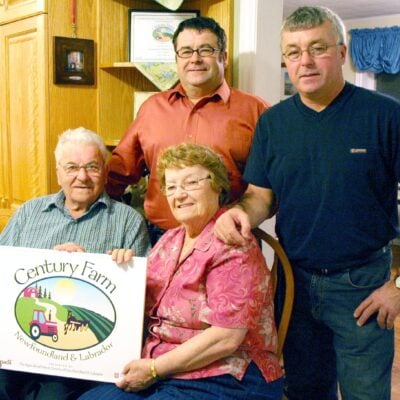
Located in Romain’s Brook, Port au Port East, Romain’s farm has a long history. It is one of the oldest farms along what was once know as the “French Shore.” The farm dates from at least 1860, if not earlier, and it has come down through the generations: Ernest Romain, Walter Romain, Charlie Romain and, at the present time, Ernest and Walter Romain.
The farm has traditionally grown vegetables and continues to do so today: cabbage, potatoes, turnip, carrots. Through much of its history, the farm has raised livestock and at one time had one of the largest sheep operations in the district. Today, in addition to vegetables, the Romains have a layer operation of approximately 5,400 birds and forage is grown as a cash crop.
The Agricultural History Society of Newfoundland and Labrador is mandated to collect and honour the history of agriculture in this province and to raise public awareness of agriculture as a theme in the story of the province. In 2005 the Society created the Century Farm Award which is meant to identify, recognize and honour any farm family who have continuously farmed the same land for one hundred years or more and who continue to farm it at the present time. This award represents the pioneering agricultural history of the province: some farms supplied the growing town of St. John’s with milk, produce, meat and forage for livery stables; other farms supplied vegetables and butter to fishing communities by coastal boat; and others sent produce and dressed poultry by rail to the new resource towns, such as Grand Falls. Some of the early farmers came directly from the British Isles and others came to Newfoundland from earlier settlements in Nova Scotia. From their early beginnings these farms have survived as productive agricultural businesses by adapting successfully to changing market demands and changing economic circumstances and by adopting innovative technology. They have kept their land in good heart through as many as half a dozen generations. The Century Farm families have earned the Century Farm Award in recognition for their contribution to the history of our province and for their commitment to agriculture in the province’s future.