Explore
 Google map
 Summer camp for sheep: Ferryland farmers send flock across the sea to fatten up

Description
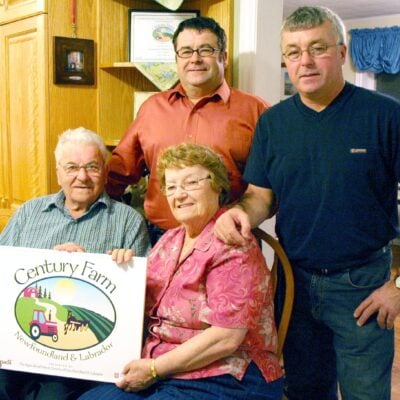
NOTE: In 2005 the Agricultural History Society of Newfoundland and Labrador created the “Century Farm Award” to honour farm families across the province who had farmed their land continuously for one hundred years or more and were still actively farming. Heritage NL agreed to post these listings on our website. Please note that these farms are NOT designated by Heritage NL. The listings are commemorative only. All content and images © Agricultural History Society of Newfoundland and Labrador and used with the permission of award recipients.
Information below was current as of 2006-2007.
Rubyvilla Farm
This Century Farm in the Goulds has belonged to the Ruby family since it was first cleared, more than 150 years ago. William Ruby, from Devon, England, arrived in Newfoundland in 1842. In 1849, William struck out on his own, taking on land to clear and create a farm. In 1863, he spoke before an Agriculture Committee of the Government and described to them how he had cleared and developed his farm: after thirteen years of hard work, he had ten good acres cleared, a good stable erected, and a fine substantial house built. Later, he purchased more land for his sons, George and Samuel.
Rubyvilla Farm is land descended through George Ruby. Sandy Ruby is the current owner-operator of approximately 35 acres. Historically, the farm supported vegetables, a little dairy, and some beef cattle. But now, the speciality is sheep.
However, Sandy Ruby has had trouble with his sheep. He used to keep them on pasture in Aquaforte but recently he has suffered losses there to coyotes. He has cut back and now keeps a flock of about 15 sheep close to home on the Ruby Line where he can keep an eye on them. “It’s a flock that we can handle at home and not have to bring them off to a pasture where the coyotes were.”
Sandy’s particular interest is in Newfoundland sheep.” The Newfoundland sheep are supposed to be hardier…but they won’t dress out as heavy as my other sheep used to. I measured my heaviest one at 98 pounds.” For the past seven years, Sandy has been involved in a project with several other farmers to save some breeds of heritage Newfoundland sheep which were close to extinction. “They are a Newfoundland breed, like the Newfoundland pony….we have got to get it … to two hundred…to get them registered. That’s the whole project, to get this Newfoundland breed registered.”
It is satisfying to reflect that Sandy Ruby is conscious of his roots in maintaining the Century Farm which his ancestors created and, at the same time, he is also working hard to bring back Newfoundland sheep from extinction, another heritage project.
The Agricultural History Society of Newfoundland and Labrador is mandated to collect and honour the history of agriculture in this province and to raise public awareness of agriculture as a theme in the story of the province. In 2005 the Society created the Century Farm Award which is meant to identify, recognize and honour any farm family who have continuously farmed the same land for one hundred years or more and who continue to farm it at the present time. This award represents the pioneering agricultural history of the province: some farms supplied the growing town of St. John’s with milk, produce, meat and forage for livery stables; other farms supplied vegetables and butter to fishing communities by coastal boat; and others sent produce and dressed poultry by rail to the new resource towns, such as Grand Falls. Some of the early farmers came directly from the British Isles and others came to Newfoundland from earlier settlements in Nova Scotia. From their early beginnings these farms have survived as productive agricultural businesses by adapting successfully to changing market demands and changing economic circumstances and by adopting innovative technology. They have kept their land in good heart through as many as half a dozen generations. The Century Farm families have earned the Century Farm Award in recognition for their contribution to the history of our province and for their commitment to agriculture in the province’s future.