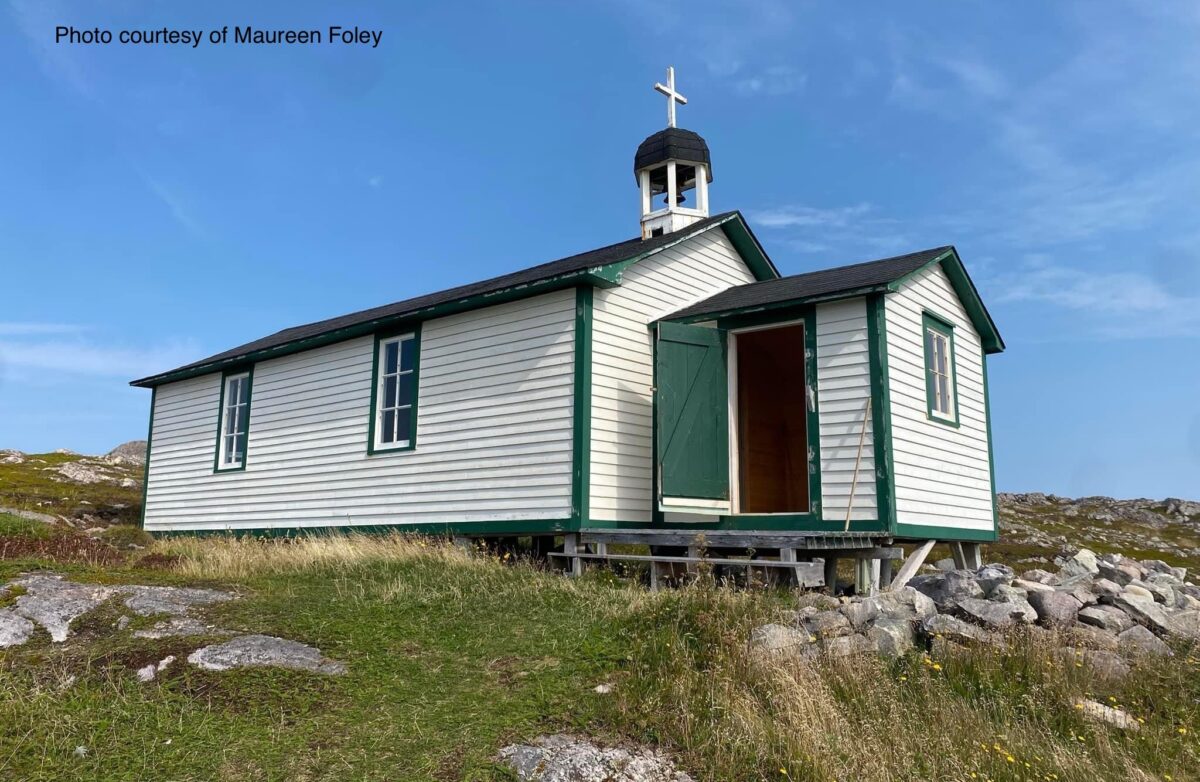
St. Anne’s Roman Catholic Church is a one-storey wooden church located in the resettled community of Little Fogo Islands. It was built circa 1867 by the predominantly Roman Catholic residents of Little Fogo Island. The designation is confined to the footprint of the building.
Formal Recognition Type
Registered Heritage Structure
Heritage Value
St. Anne’s Roman Catholic Church was designated a Registered Heritage Structure by the Heritage Foundation of Newfoundland and Labrador in 1995 due to its historic, aesthetic, and cultural value.
St. Anne’s Roman Catholic Church has historic value as a remnant of the community of Little Fogo Island. Little Fogo Island has a history of permanent and seasonal settlement going back centuries. The first official record of settlement is in the 1857 census, which recorded 18 residents – seventeen identifying as Roman Catholics and one as Church of England. No church buildings were reported as being present at that time. By 1884, the population had swelled to 120 – all identifying as Roman Catholic – and a Catholic church building was recorded. Five years later, in 1889, a report on public schools under the Roman Catholic board noted that many residents were “acting on the sensible advice of their parish priest, Father Walker, and are fast abandoning these isolated rocks to establish themselves in Loon Bay and other districts.” The report noted that those who had left returned during fishing season and that only three families were staying for the winter. The 1891 census recorded 68 residents, all Roman Catholic. The 1901 census recorded 77 residents, again all Roman Catholic. A 1907 article in The Evening Telegram reported that the island had been completely abandoned for the winter months but the 1911 census records 47 residents, all Roman Catholic. The island isn’t mentioned in the 1921 census but the 1935 census – the last one to include numbers for Little Fogo Island – notes a population of 21, all reporting to be Catholic. Little Fogo Island is listed in the 1941 post office circular but there is no mention of the settlement in the 1945 census. By this time, most residents had permanently moved to other settlements (the Donahue family is reported to have stayed year-round until 1970) while continuing to return to Little Fogo Island for fishery purposes. Some of the homes and fishing premises on the island continue to be maintained, as is St. Anne’s Roman Catholic Church.
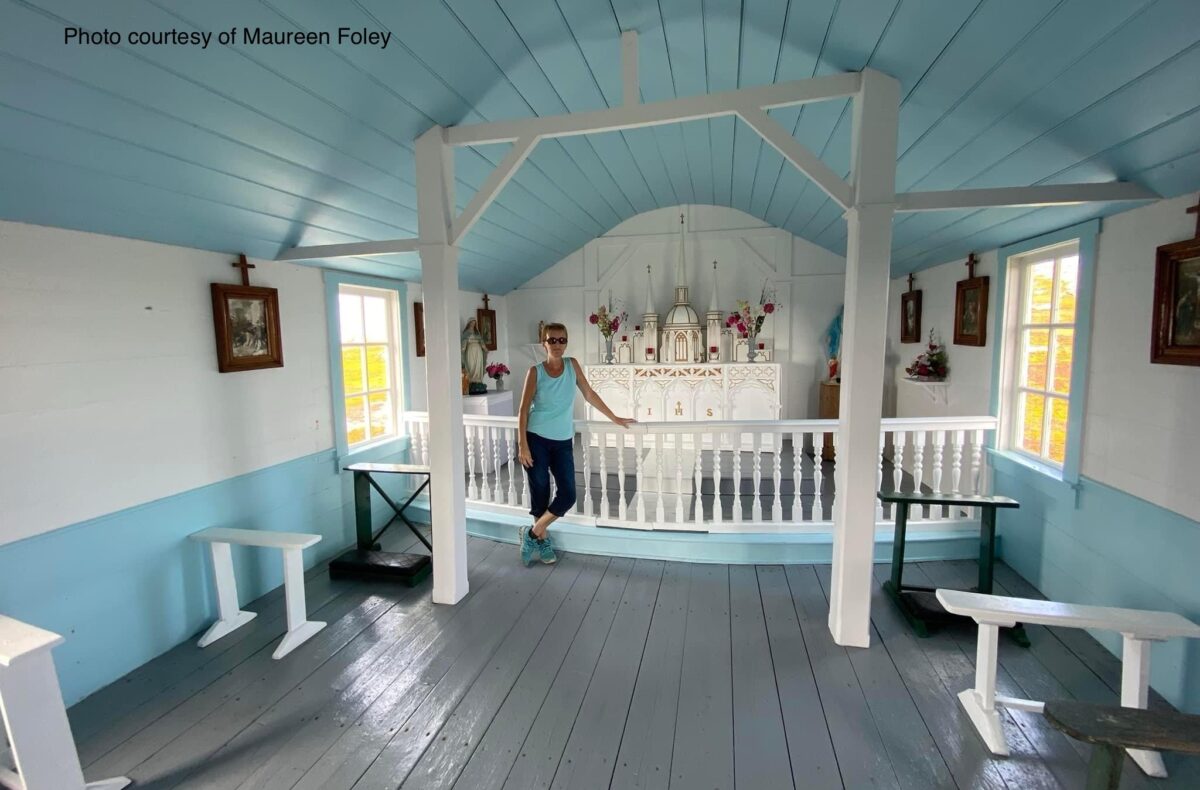
St. Anne’s Roman Catholic Church has historic and cultural value due to its age and continued efforts to maintain the building over generations. A sign in the church’s porch notes that it was built in 1867. The 1884 census records the church as being present. A construction date anytime between those years makes the church one of the oldest in the region. The church would have been served by the priest from the Roman Catholic parish in Tilting and it would have been built and maintained by the parishioners of Little Fogo Island. Given the fluctuating population and the seasonal nature of settlement on the island, it is a testament to the builders and their descendants that the church has remained in good physical shape since the time of its construction. Both the interior and exterior are well maintained, offering a glimpse into the aesthetics of places of worship from the time period.
St. Anne’s Roman Catholic Church has aesthetic value for its simplicity and as an excellent example of a well-preserved mission church. The construction of St. Anne’s Roman Catholic Church is simple yet sturdy. It was built to withstand the elements of the harsh Newfoundland climate. The builders employed the construction technique of using trunnels. Trunnels are wooden pegs often known as “tree nails.” Holes were bored in the framing timbers and the trunnels were then used to fasten the timbers together. The church was built to be functional not ornate, and the simple design is reflective of this goal.
St. Anne’s Roman Catholic Church has further aesthetic value due to its environmental setting. Located on a high hill, it was an important landmark visible from both land and sea. It was traditionally used by fishermen for marking fishing grounds and navigating through rocks and shoals. In foggy weather, the local people rang the bell to help guide fishermen back into the harbour.
Source: Heritage Foundation of Newfoundland and Labrador property file “Little Fogo Island – St. Anne’s Roman Catholic Church – FPT 1584”
Character Defining Elements
All those features that speak to its age, construction, and outport vernacular building design, including:
-rectangular layout;
-number of storeys;
-mid pitch roof;
-size, style, trim and placement of domed bell cupola;
-returned eaves;
-wooden trunnel construction;
-narrow wooden clapboard;
-wooden corner boards;
-size, style, trim and placement of wooden windows;
-size, style, trim and placement of exterior wooden doors;
-size, style and location of porch;
-domed ceiling on the interior and interior woodwork;
-dimension, location and orientation of building.

 Google map