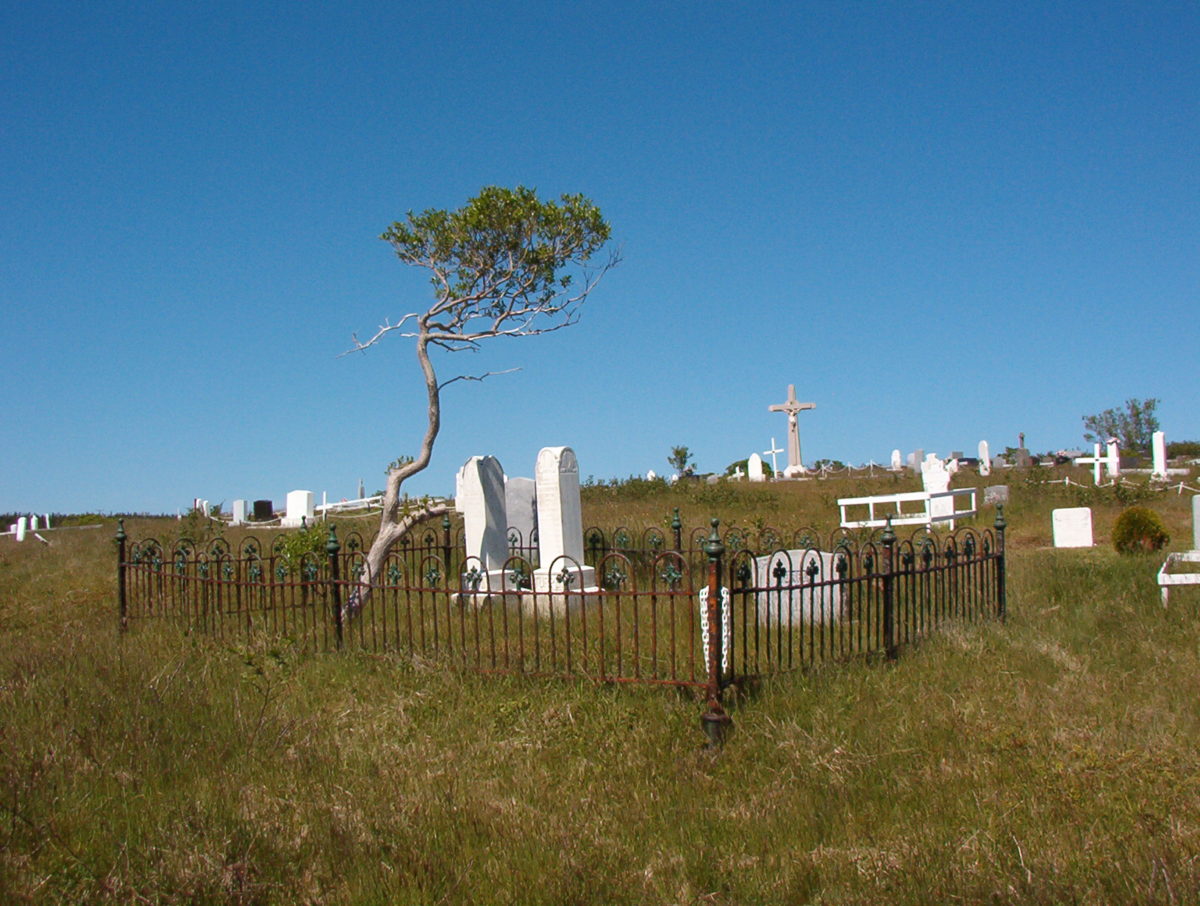
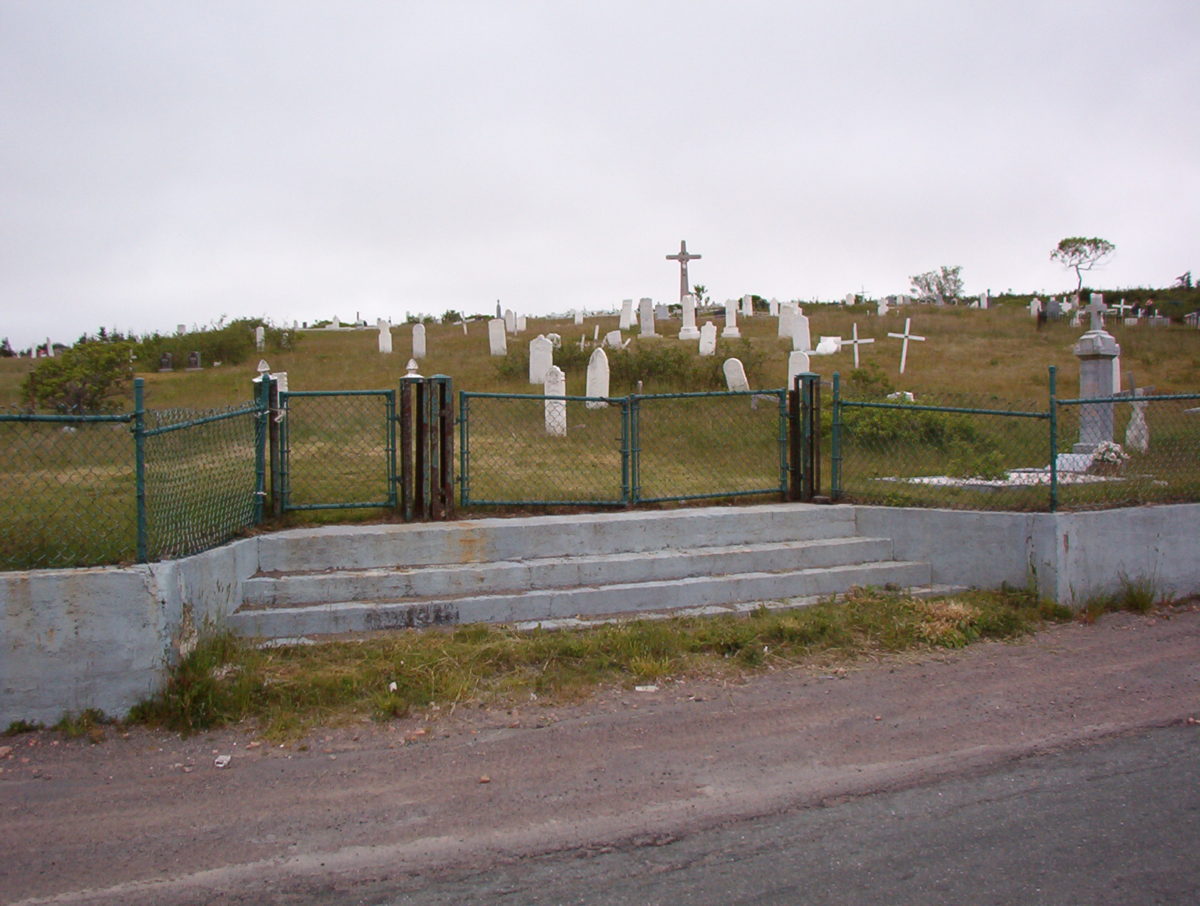
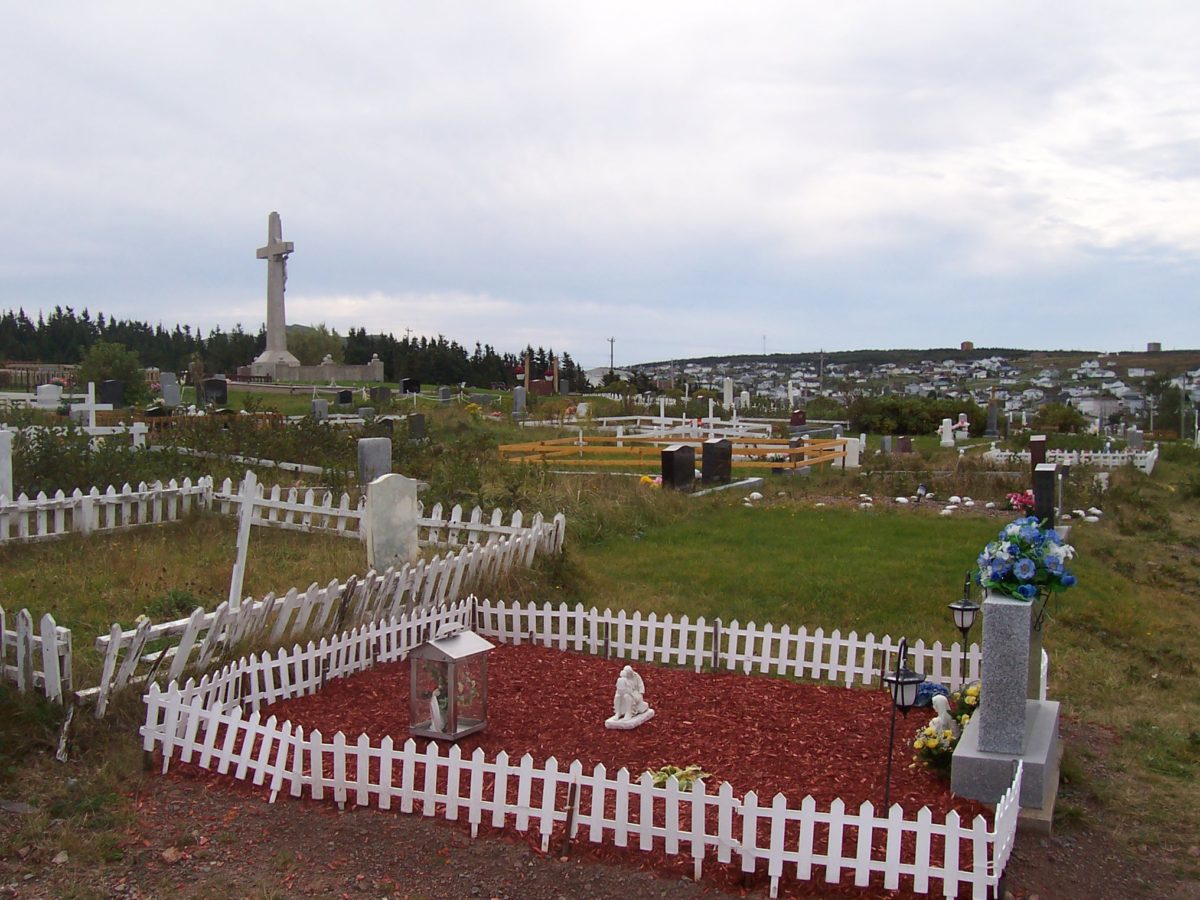
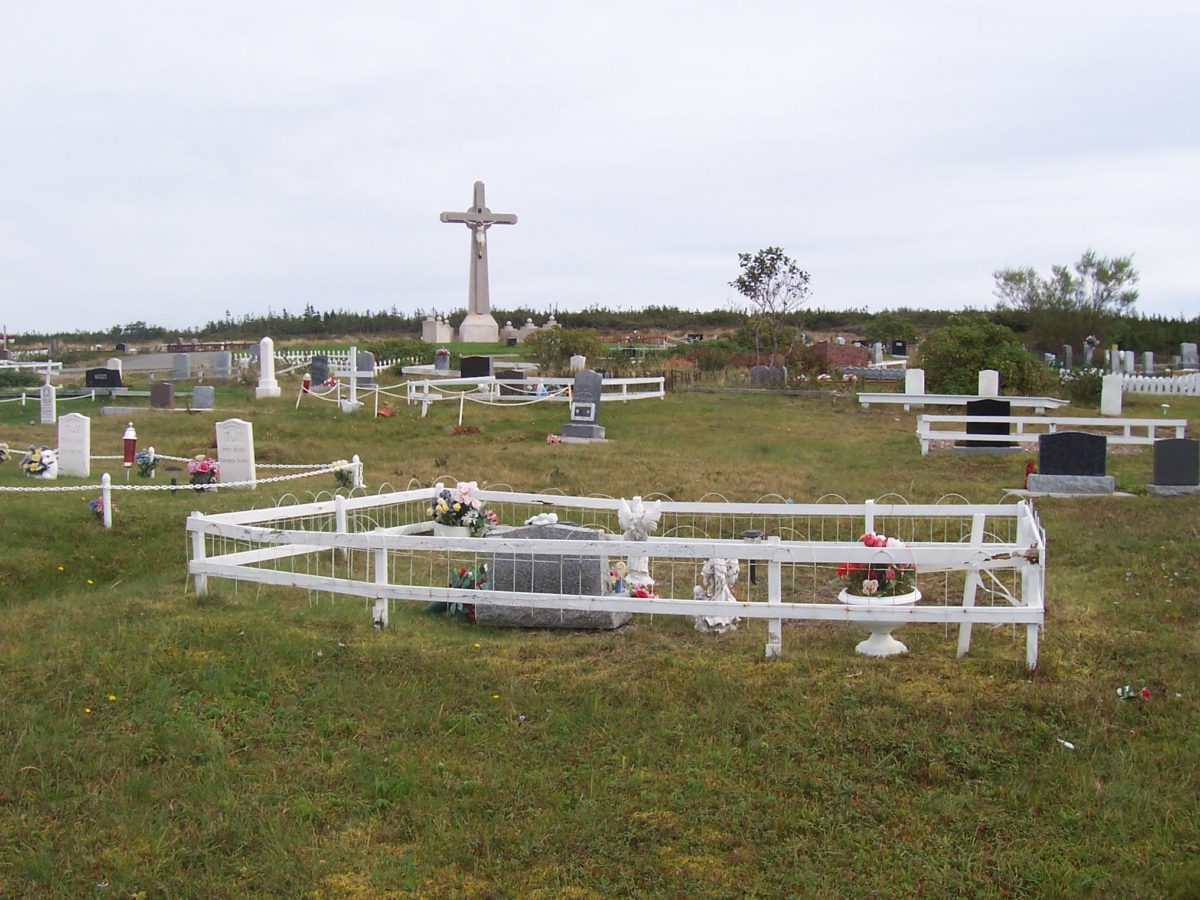
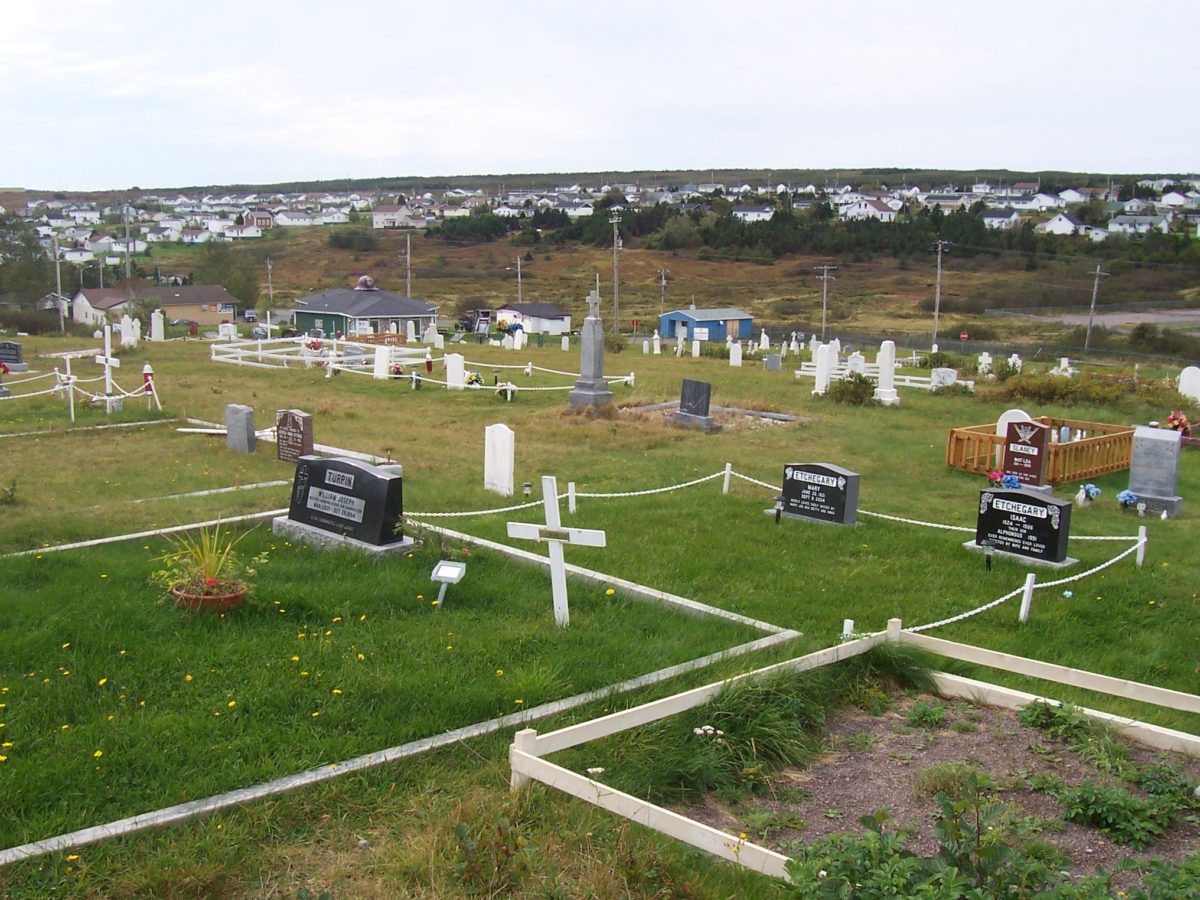
St. Cecilia Roman Catholic Cemetery is a burial ground located off Route 220 at the northwest end of the harbour in St. Lawrence, NL. It is a fenced cemetery with over 600 grave plots and has been in use since the nineteenth century. The designation encompasses the whole fenced area.
Formal Recognition Type
Municipal Heritage Building, Structure or Land
Heritage Value
St. Cecilia Roman Catholic Cemetery has been designated a municipal heritage site by the Town of St. Lawrence due to its spiritual, historic and aesthetic value.
St. Cecilia Roman Catholic Cemetery has spiritual and historic value as a consecrated Roman Catholic burial ground in use for over a century. While its earliest extant gravemarker records a death date in 1869, St. Cecilia Cemetery was likely in use before that time. Roman Catholicism was the predominant religion of St. Lawrence’s settler population in the early nineteenth century, and the local parish was officially established in 1849.
St. Cecilia Roman Catholic Cemetery has historic value through its connection to a prominent event in the area’s history. On February 18, 1942 three American navy ships went aground during a storm. 203 crew members of the USS Truxton and USS Pollux were lost, although local residents helped save 186 sailors. The Roman Catholic Episcopal Corporation transferred a section of St. Cecilia Cemetery to the United States government for use as a military cemetery. The bodies of 51 shipwrecked sailors were temporarily interred there and then eventually transported to the United States after World War II and the US government transferred the cemetery land back.
St. Cecilia Roman Catholic Cemetery has historic value for its connection to St. Lawrence’s flurospar mining industry, which was a major employer and mainstay of the local economy from the 1930s into the 1970s. St. Cecilia and other area cemeteries underscore the sad side of the town’s mining heritage, for there are interred the bodies of miners whose deaths have been linked to industrial disease contracted in fluorspar mines.
St. Cecilia Roman Catholic Cemetery has historic value as a physical record of St. Lawrence’s past. Its gravemarkers are inscribed with information pertaining to genealogy, such as familial relationships and dates of birth and death, and local history, including information about tragic events such as shipwrecks. The gravemarkers can thus be considered as artifacts to the community’s landscape. While there is at least one instance of limestone, most of the older markers are white marble in tablet or column forms (typical of their age) and most of the newer ones are granite. The designs of many of the markers include religious iconography associated with the Catholic faith. Some of the more recent headstones include soccer motifs, underlying the area’s particular affinity with the sport.
The gravemarkers also contribute to the cemetery’s aesthetic value, along with the array of fencing in wood, masonry, metal or concrete demarcating the boundaries of individual or family grave plots, and the organic way in which the layout of the plots has evolved over the years. A large, erect, concrete crucifix on site marks the cemetery as a Christian one. Together with the grassy cemetery’s prominent, roadside location, these elements make St. Cecilia Roman Catholic Cemetery a distinctive landmark in St. Lawrence.
Source: Town of St. Lawrence motion 05-128, designated at a regular meeting of the St. Lawrence Town Council held August 16, 2005.
Character Defining Elements
All those extant features which contribute to the historic and aesthetic value of the cemetery, including:
-inscriptions and designs of gravemarkers;
-preponderance of marble headstones amongst the older gravemarkers;
-grave plot boundary fencing in wood, concrete, masonry or metal;
-concrete crucifix;
-grassy groundcover, and;
-prominent location off main road.
Notes
Surnames recorded on gravemarkers in the cemetery include: Alyward, Burry, Brackett, Brenton, Brewer, Brinston, Brisson, Brown, Burke, Churchill, Clarke, Coady, Collins, Cusack, Cusick, Cuza, Dober, Dodeman, Downs, Doyle, Drake, Dunphy, Earle, Edwards, Emberly, Etchegary, Farrel, Ferrie, Fewer, Fitzpatrick, Flanningan, Fowler, Ghaney, Giovannini, Haley, Handrigan, Harnet, Hodder, Holmes, Kearney, Kelly, Kettle, Lacey, Lake, Lambe, Lambert, Lannon, Letertre, Loder, Lundrigan, Maddigan, Melloy, Miller, Molloy, Mondry, Murray, O’Reilly, Paul, Perrot, Pike, Pittman, Power, Poynter, Quirke, Reha, Rennie, Robere, Roul, Saint, Shea, Slaney, Spearns, Stacey, Stapleton, Strickland, Tarrant, Tilley, Tobin, Turpin and Walsh.
Older headstones identify several of the deceased as Italian immigrants from Lucca, explaining the appearance of the family name Giovannini in St. Lawrence. The first Giovanninis there were merchants in the 1860s. The headstone of Robert Pike indicates that he died in December of 1917 upon the wreck of the schooner Creusa Giovannini.
In 1929 a tsunami that devastated the St. Lawrence area entered the lower corner of the cemetery and toppled some of the headstones.
The Memorial Miners’ Museum at St. Lawrence is located across the road from Mount Cecilia Cemetery. The light atop the replica miner’s helmet on the roof of the building shines into the cemetery at night.

 Google map
 Website