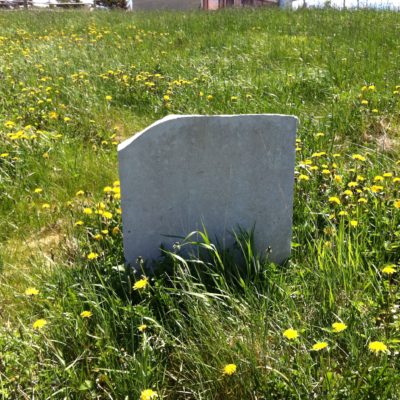
The Telegraph Station Ruins (Borden # ClAl-04) are located approximately three quarters of a kilometre from the shores of Sunnyside, NL, overlooking the waters of Bay Bulls Arm, Trinity Bay. The ruins are comprised of the remains of foundations laid during the construction of telegraph infrastructure in the community. The designation is confined to the space identified as the Telegraph Station Ruins.
Formal Recognition Type
Municipal Heritage Building Structure or Land
Heritage Value
The Telegraph Station Ruins were designated a municipal heritage site by the Town of Sunnyside because of their historic value.
The Telegraph Station Ruins have historic value for their association with the development of international communication technology. In 1856 a telegraph cable had been laid between Cape Ray, Newfoundland and Cape Breton Island, Nova Scotia. This cable in turn linked to the mainland of North America. Beginning in the summer of 1857 several companies, including the “New York, Newfoundland, and London Telegraph Company” (founded in 1852), and “Atlantic Telegraph Company” (founded in 1856) made attempts to lay a transatlantic cable from Ireland to Newfoundland, which would hook up with Newfoundland’s overland telegraph line, this completing a link between Europe and North America. After two failed attempts in August of 1857 and June of 1858 to lay the first transatlantic cable between Europe and North America, the HMS Agamemnon and the USS Niagara set out on July 17, 1858 determined to complete the task. On July 29, 1858, the ships met in the mid-Atlantic Ocean and spliced the two ends of the cable together. The HMS Agamemnon set sail towards Ireland while the USS Niagara sailed towards Newfoundland. The USS Niagara arrived in Sunnyside (then known as Bay Bulls Arm) at 2:10am on August 5, 1858. By 6:00am, with the help of smaller boats, the 5/8-inchdiameter cable was brought ashore. To commemorate the successful laying of the cable, the sailors of the USS Niagara erected a mast in Sunnyside, naming the spot, Niagara City. The Agamemnon arrived in Valentia, Ireland the following day. By this time the Atlantic Telegraph Company had built a station in Sunnyside. One hundred men gathered to pull the cable overland through a path cut through the woods to the Atlantic Telegraph Company station, approximately three quarters of a kilometer from the beach. The New York, Newfoundland, and London Telegraph Company’s only infrastructure there at the time was a telegraph key set up on a makeshift table in the woods. By the following year they too had constructed a station.
Mr. C. V. de Sauty, who joined the Atlantic Telegraph Company in 1856, designed both the Atlantic Telegraph Company and the New York, Newfoundland, and London Telegraph Company stations at Sunnyside. He served as superintendent in Sunnyside during the period that the cable was in service. He received the first test currents from Valentia, Ireland on August 9, 1858. By August 10th, test messages were being sent from Sunnyside to Valentia. By August 16, 1858, 129 messages had been sent across the Atlantic Ocean. On August 16, 1858 Queen Victoria sent a message to United States President James Buchanan, that in part read “The Queen is convinced that the President will join with her in fervently hoping that the electrical cable which now connects Great Britain with the United States will prove an additional link between the two nations.” Transmissions became intermittently faulty on September 1st the cable stopped functioning. By 1861 the cable station was unstaffed, and when James P. Howley visited the site in 1869, the structures and materials had largely been reclaimed or sold. The Adams family in Come by Chance used several of the structures as out buildings and Captain William Stevenson turned one into a family home in Harbour Grace.
Although the Sunnyside experiment had failed, it showed that it was possible to connect Europe to North American via a communications cable. Lead by Cyrus Field – a stakeholder in both the Atlantic Telegraph Company and the New York, Newfoundland, and London Telegraph Company – efforts continued to improve the technology used and to raise capital. Eight years later, on July 27, 1866, another transatlantic cable was successfully landed at Heart’s Content – which became a communications hub for transmitting and relaying messages across the North Atlantic.
The Telegraph Station Ruins have further value as artifacts on the landscape that speak to an important era in the community’s past. Although the cable station buildings were removed, the stone foundations they were built on remain. Surveys conducted by the Newfoundland and Labrador Provincial Archaeological Office have documented sections of dry-laid stone foundations, drainage trenches, a cobble pavement, a fireplace, and various artifacts and fragments of construction material.
Source: Town of Sunnyside Regular Council Meeting, Motion #21-11-25-08, November 25, 2021.
Character Defining Elements
All those elements which represent the historic value of the Telegraph Station Ruins, including:
-remaining rock walls;
-historic drainage trenches;
-cobble pavement;
-remains of fireplace;
-any other archaeological resources found or yet to be found on the site;
-dimension, location and orientation of remains, and;
-association with the laying of the first transatlantic communications cable.

 Google map
 Town of Sunnyside Facebook Page