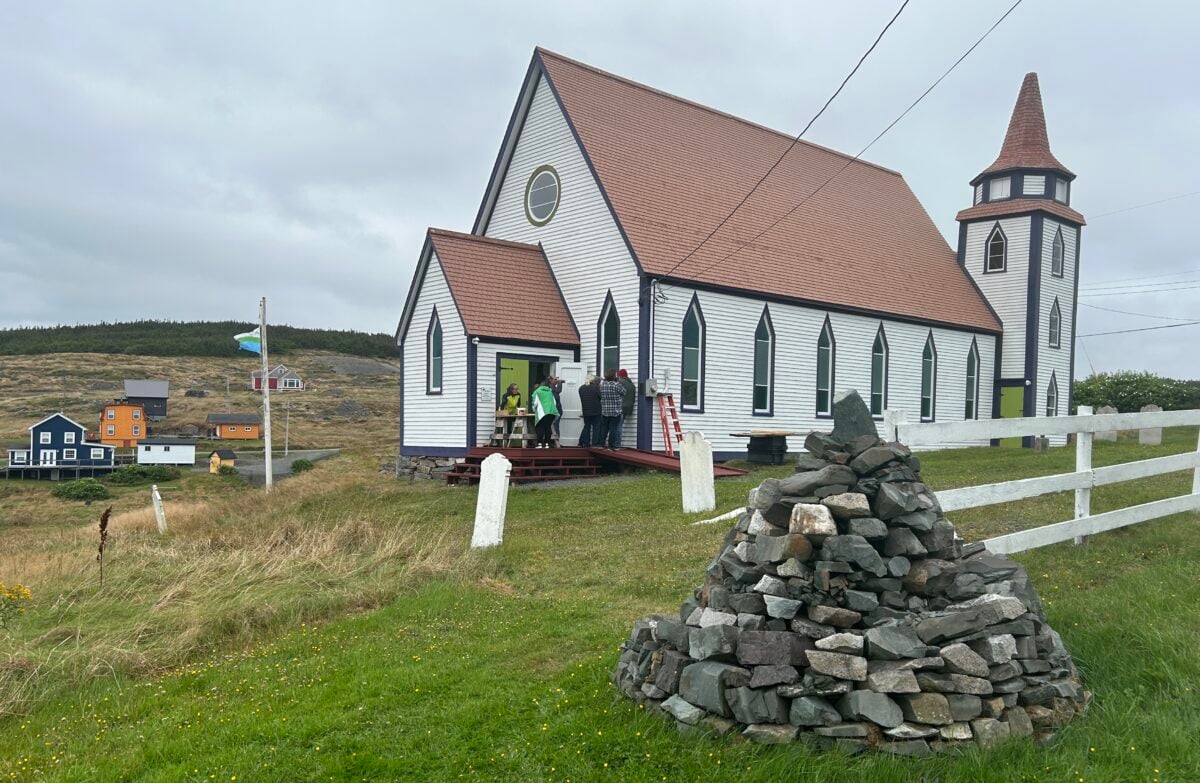
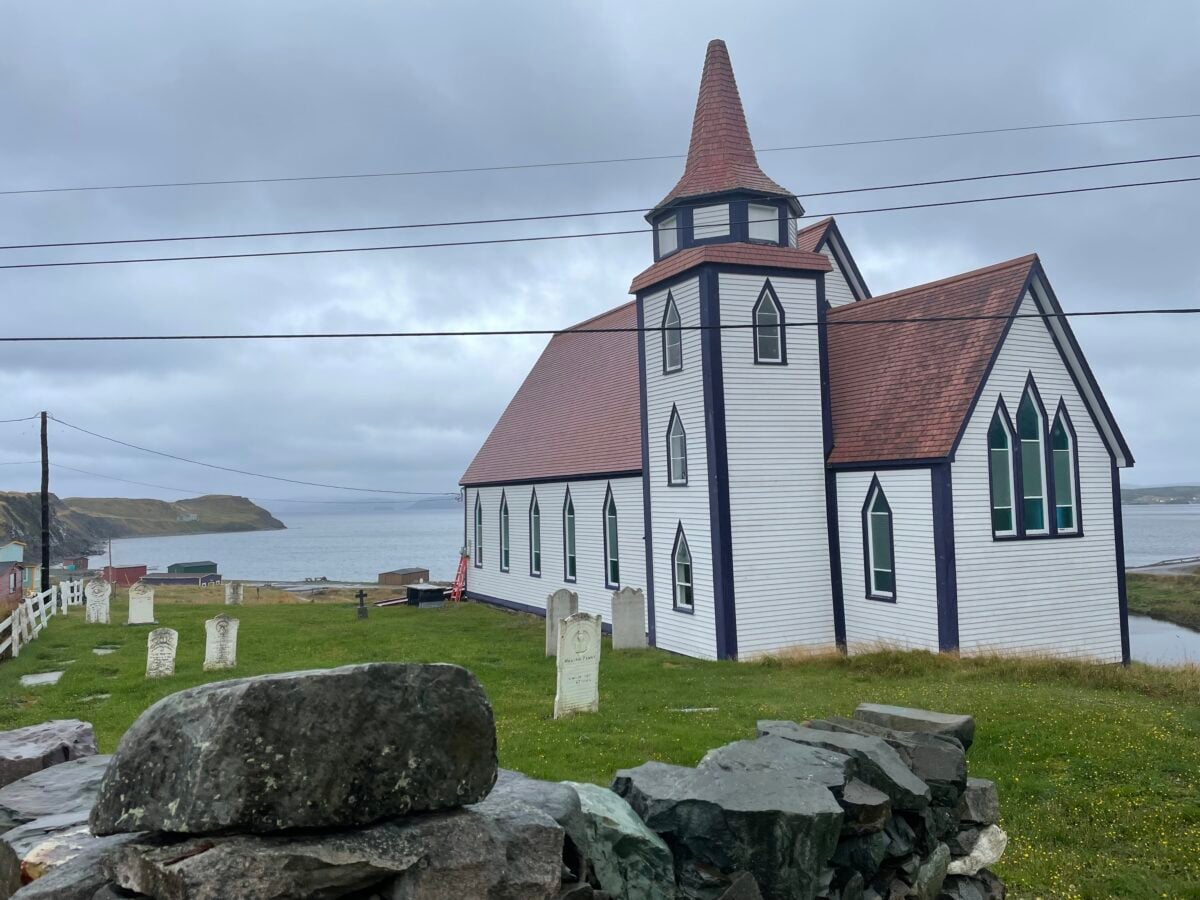
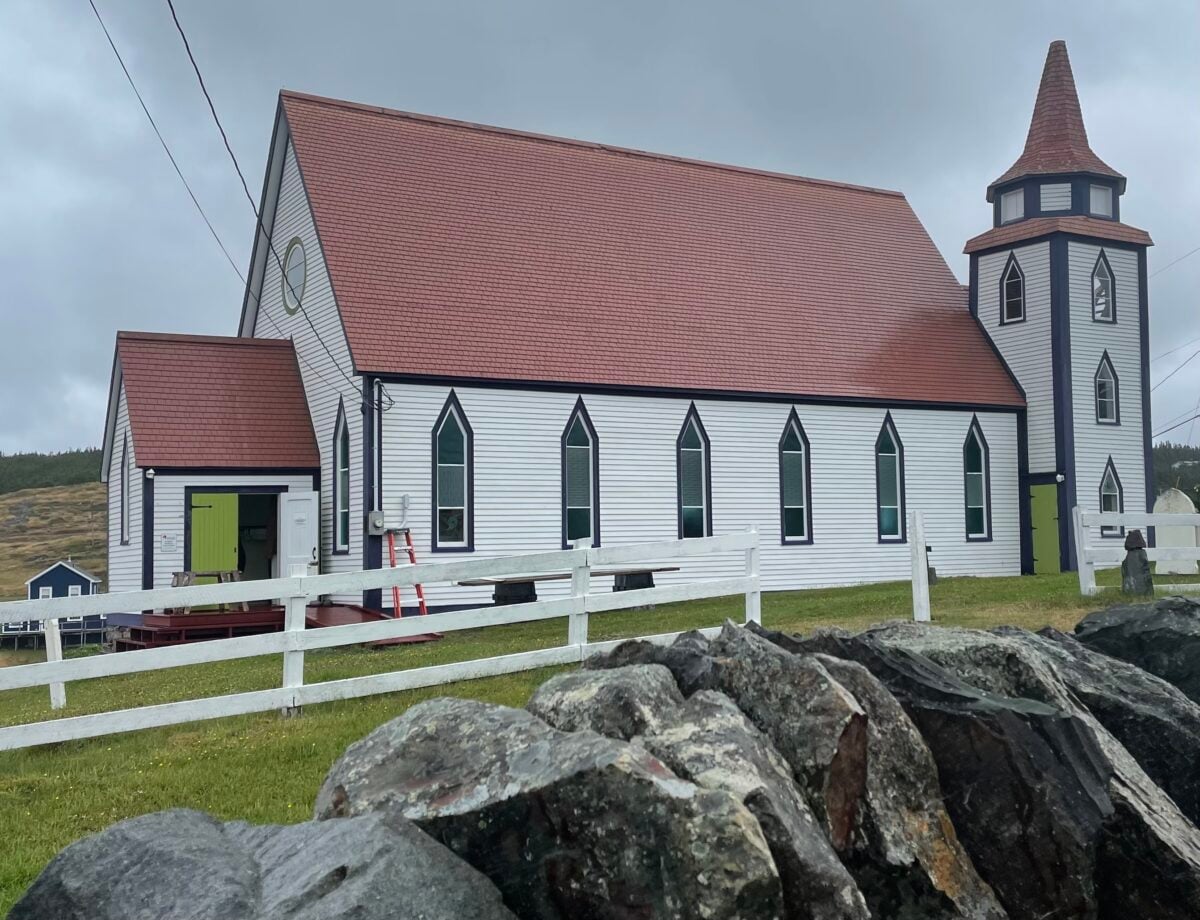
All Saints Anglican Church is a wooden Gothic Revival church located on a hill in English Harbour, NL. The designation encompasses the church and cemetery.
Formal Recognition Type
Registered Heritage Structure
Heritage Value
All Saints Anglican Church was designated a Registered Heritage Structure by the Heritage Foundation of Newfoundland and Labrador in 2005 due to its historic and aesthetic value.
All Saints Anglican Church has historic value due to its age. It replaced an earlier church, St. Silas’, which had been built by 1829. In November of 1893 an initial appeal for funds to replace St. Silas was issued in the Diocesan Magazine. An article in the July 1894 edition of the same publication reported that St. Silas “bear[ed] traces of age and decay,” but only $2 had been donated to the fund to replace it. The April 18, 1896 edition of The Weekly Record reports that the men of English Harbour had spent two days cutting the frame for a new church. By December of 1897 the congregation of St. Silas’ had to conduct services in the school. In 1898, St. Silas was “carefully taken down,” not burned as is reported in other sources, and on December 9, 1898, a ceremony was held to lay the cornerstone for a new church. That same month, a sale of work by “the committee of women under the leadership of Mrs. Fancy” raised $105 for the church fund. By July of 1899, the Diocesan Magazine reported that the frame of the new church had been raised on a stone foundation and the sides were boarded in.
The Diocesan Magazine reported that on Sunday, November 4, 1900, Church of England Bishop Llewellyn Jones consecrated the new All Saints Church in English Harbour, although it was noted that some elements of the new church were unfinished, including the tower and seating. The article thanked the Building Committee and the women of the congregation for all the efforts they made toward the construction of All Saints. A month later, “The women of All Saints…held a sale of work in Christmas week” to raise funds to build the tower. A June 1901 report noted that the tower was yet to be started. A report from 1904 mentioned that enough paint had been bought to paint the whole exterior, and that the children, churchwardens, and women were all raising funds for seating. In 1905, it is noted that “the women have been to the fore and raised $90, which will finish the seating of All Saints Church and leave a balance for other objects.” All Saints Anglican Church would serve the community for over 100 years, until it was deconsecrated in 2005 and bought by the English Harbour Arts Association.
The adjoining cemetery has historic value for its age and the length of time it was used as a burial ground. The earliest date on an extant headstone is 1811. The first Church of England church was built in English Harbour around 1800 and the second in 1829. It is reported that in July of 1832, Bishop John Inglis consecrated the second church and a burial ground in English Harbour. The burial ground referred to was most likely the one surrounding All Saints Anglican Church, even though some headstones predate the 1832 consecration. In 1912, another Church of England cemetery was consecrated in English Harbour, meaning that the cemetery surrounding All Saints was in use for well over a century. Notable burials include 3 victims of the Trinity Bay Disaster of February 27, 1892. A fierce storm caught numerous men off guard while they were hunting seals that had floated into the bay on loose ice, resulting in the deaths of several men from the area. The cemetery also contains a war memorial honouring residents who served and died in both World Wars.
All Saints Anglican Church has aesthetic value because it is a good example of outport Gothic Revival style, constructed of wood and featuring a steeply pitched roof. Long, pointed arch windows, some with textured, coloured glass, line both sides of the church. Above the main entrance porch, high in the gable is a round window. At the rear is the chancel, featuring three pointed arch windows, and a square tower with a low spire. All Saints Anglican Church has further aesthetic value due to its environmental setting. It is located on a high open space facing the harbour. The church was traditionally used as a navigational aid for mariners due to its visibility from the ocean.
Source: Heritage Foundation of Newfoundland and Labrador property file “English Harbour – All Saints Anglican Church – FPT 257”
Character Defining Elements
All those elements that define the Gothic Revival style of architecture, including:
-number of storeys;
-steeply pitched gable roof;
-wooden roof shingles;
-narrow wooden clapboard;
-wooden corner boards;
-size, style, trim and placement of wooden pointed arch windows;
-size, style, trim and placement of wooden round window in gable;
-use of textured blue glass in windows;
-size, style, trim and placement of exterior wooden doors;
-size, style and location of porch on front facade;
-size, style and location of chancel on rear facade;
-size, style and location of tower and spire on rear facade;
-dimension, location and orientation of building.
All those elements of the associated cemetery, including:
-original memorial stones and monuments with their surviving inscriptions;
-style, placement and materials of gravemarkers;
-grassy groundcover;
-wooden fence outlining the shape of the cemetery, which reflects its growth around the churches that stood on the site;
-its association with the Church of England/Anglican religion.
All those elements that relate to the location of the church, including:
-prominent location on a hill overlooking the ocean;
-visibility from many vantage points in the community.
 Google map
 English Harbour Arts Association Website