Explore
 Google map
 Murray Garden Centre Website

Description
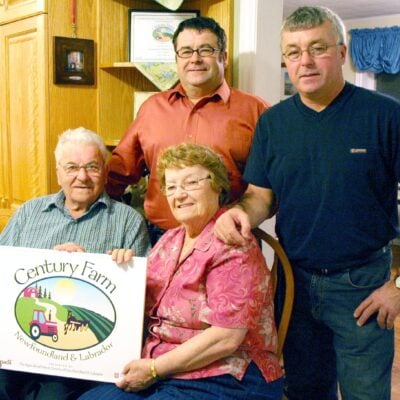
NOTE: In 2005 the Agricultural History Society of Newfoundland and Labrador created the “Century Farm Award” to honour farm families across the province who had farmed their land continuously for one hundred years or more and were still actively farming. Heritage NL agreed to post these listings on our website. Please note that these farms are NOT designated by Heritage NL. The listings are commemorative only. All content and images © Agricultural History Society of Newfoundland and Labrador and used with the permission of award recipients.
Information below was current as of 2006-2007.
The Murray Farm
To this day, when Michael Murray ploughs his land on the hill over-looking Portugal Cove, he finds beach stones buried in the earth. Round and smooth, shaped by time and salt spray- the stones are far from their home on the shore. He pockets them, keeping every one he finds; a reminder of his ancestral ties to the land. “They would take fish offal from the coast with teams of horses,” Murray settles back in his office chair and recites the farming practices of his ancestors. “They used capelin, mixed it with peat and vegetable offal, and spread it on the land.” Murray’s knowledge of the ancient farming practices are so thorough, you could almost believe he lived it himself. “I collect the beach stones I find in the fields, because every time I find one, it’s a memory for me of that work and that effort from that time.”
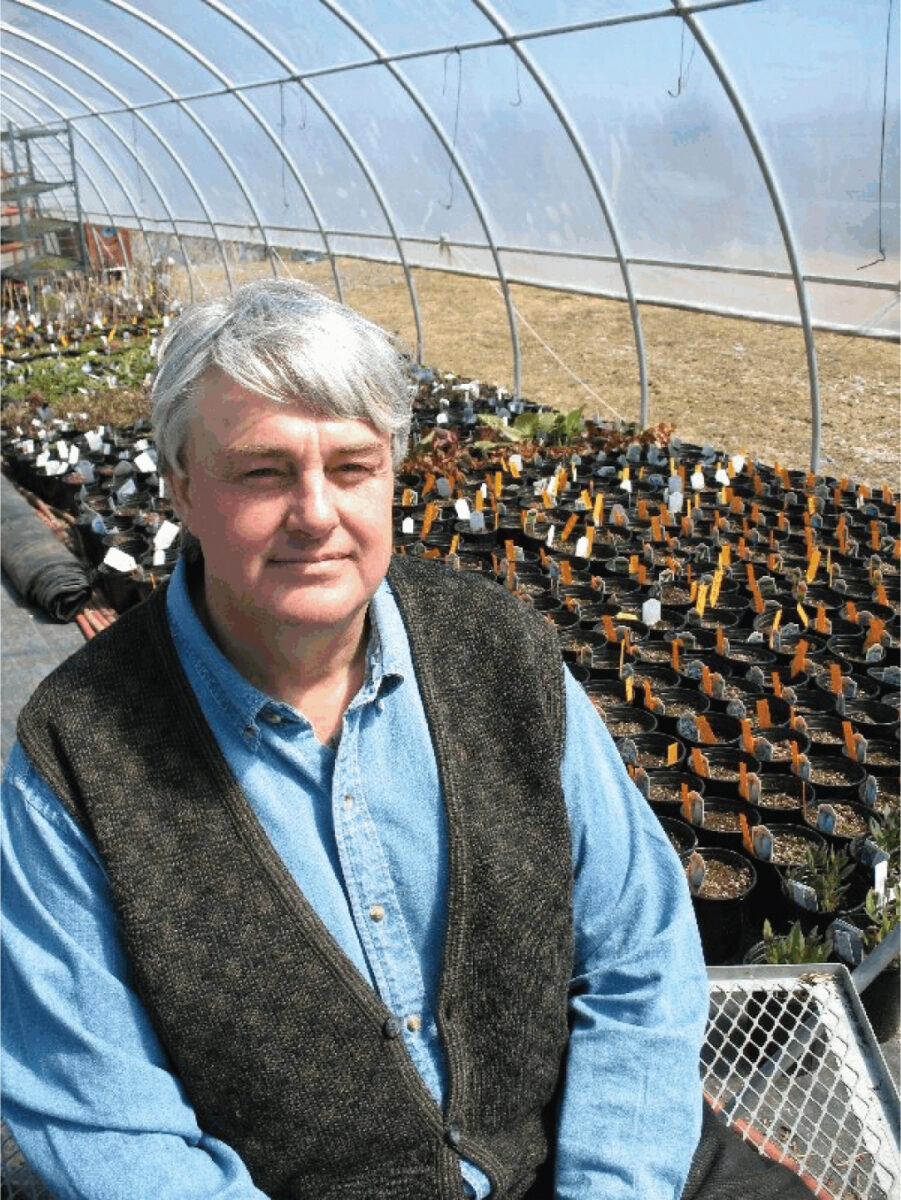
Today, Michael Murray sits behind a cluttered desk in an office above his retail shop. Sketches and maps, rolled and stacked, cover the surfaces. Outside, the icy February wind whips along the highway, but inside Murray’s Garden Centre in Portugal Cove, the staff have already turned their minds to spring; in the greenhouses outside, seedlings are sprouting under heat lights.
What began as an Irish immigrant’s subsistence farm in 1820, is now a multi-million-dollar horticulture business: Murray’s Garden Centre and Horticultural Services. Murray’s handles gardening contracts for government buildings, shopping centres, and the top hotels in St. John’s. Not to mention the everyday business of potted flowers and plants that brings crowds of home gardeners to Murray’s all year round.
Patrick Murray arrived in Newfoundland in 1816 and settled in Portugal Cove four years later to farm. He liked the strategic location of the area; its proximity to the sea and its prime location on the main road between the growing city of St. John’s and Carbonear.
Patrick Murray began ploughing the land, and cutting timber for the house – a house that stands today, on top of the original root cellar. “I expect for the first couple of winters here, they used the cellar to get in out of the weather and made that their home, then they built the house around it,” Murray says.
As the family grew used to the frigid winters in the new world, they began to expand their farm and cultivation techniques. “These guys didn’t know it but they were truly organic farmers,” Murray says. “ In the composting, they were using wood ash, collected from the city, which provided potassium. They had no pesticides, and no fertilizer, but they using natural fertilizer –“nutrient tea” – liquid manure from animals.”
The Murrays of the early 1800s were resolute in not repeating the agricultural mistakes of their Irish homeland: a lack of rotation of crops, subdivision of land and a high dependence on one crop. Those poor agriculture practices in Ireland would eventually lead to Irish potato famine of 1845 – a plight that would bring death to hundreds of thousands of Irish.
Michael Murray credits his family’s perseverance and success to their knowledge of the land. “They learned that from their own cultural experiences in Ireland. They were determined not to repeat the errors of their forefathers in Ireland with poor farming practices.”
Patrick expanded the farm to 175 acres, which is what it still is today, by laying claim to the nearby “tilting lands” of fishermen; small, subsistence farms set up by fishermen when they were not at sea. “The fishermen never kept much claim to the land, they were very transient about it. What my ancestors did was purchase, or assemble the tilting lands and made them part of the holdings,” Murray says.
In those early days, Patrick Murray grew vegetables to sell in the city of St. John’s, as well as to the community of Portugal Cove and the traffic that used the road to Carbonear. The farm also kept some livestock, such as goats, pigs and fowl.
In 1849 Patrick died, leaving his wife, Catherine Vey, to continue on with the farm. “She was very much the matriarch of family, she kept it together, kept it moving forward, kept it very much intact. It was interesting to see a woman do that at that time,” Murray says. Patrick’s son, also named Patrick, kept the farm going until 1911. The farm was prosperous enough by that time to employ people from the community.
Patrick’s son, Michael, shares his name with the current proprietor of the Murray land. In the earlier twentieth century, the senior Michael took the Murray farm on the first of its forays into alternative agriculture, by building the first fox farm in Newfoundland. “It was a great location for a fox farm,” Murray explains. “Because of the amount of fish coming out of Portugal Cove, for feed. Then the offal from the foxes went into compost for the vegetables on the farm.”
Michael speaks fondly of his grandparents, Michael Murray and Mary Burke. She was the local school teacher from Flatrock. “She taught people to read and write and she was held with high regard in the community,” Murray says. “She read to people in the community. They would come to the house and she would read, things like Charles Dickens, to them for entertainment. That was appreciated, and she became very welcome in the community.”
Murray also credits the success of his family’s farm to their relationship with the community. “Once, when I was about 10 or 11 years old, I took the last bus home to Portugal Cove from school in St. John’s. It was known as the ‘working man’s bus’ because it left the city just after all the men got off work. I remember the men on the bus were having a drink in the back, and there I sat, in my school blazer, with the little crest, and a man said to me, ‘now who is this young gentleman?’ ‘Michael Murray,’ I said. Right then, in the blink of an eye, he said, ‘my boy, come sit down next to me. You’re named after your grandfather, aren’t you? Your grandfather fed us in the cove. If it wasn’t for your grandfather, we wouldn’t have had vegetables and we wouldn’t be doing as well as we are now.’ Murray smiles proudly at this memory. “There was an abundance of food, milk, and so they shared,” he says. “Their longevity is really a due to their reverence for the community, the connection to the community, their connection to the land.”
Mary Burke placed a high value on education, and despite the depression that hit hard in Newfoundland and the pressures of maintaining the farm on her own, she managed to send her four children to school at the prestigious Catholic schools in St. John’s – St. Bonaventure’s and Littledale. “My grandmother was a great proponent of the ideal that education was the path to liberty and a prosperous future,” Murray says.
Michael’s father, Patrick, the fourth generation, followed the path his mother Mary set, graduating from McGill University in the late 1930s with a degree in soil science. He returned to Newfoundland, and while working on the farm, he also began his career with the Commission of Government in the Department of Natural Resources. He mapped the soils in the agricultural areas of Robinsons, Markland, and Cormack. After Confederation, Patrick accepted a position with the new provincial government and eventually became Deputy Minister in the Department of Mines, Agriculture and Resources. He was responsible for developing much of the policy framework for today’s modern agricultural industry.
While busy with his government career, Patrick downsized the farm in production, although not in acreage. However, the family maintained about 20 head of cattle, some geese, ducks and sheep. Produce was sold to local grocery stores and customers in Portugal Cove.
Patrick’s son Michael, the fifth generation and the present incumbent, followed his father’s footsteps. He graduated from McGill University with a horticultural sciences degree in 1978. Michael Murray returned to Portugal Cove with his young family to do what he knew best – to farm. On the family farm. The buildings from his grandfather’s fox farm were still on the property, so he moved into one, turning a back pelting room into an apartment for his family, and began growing vegetables. The first year, they grew 20 acres of produce and sold it in crates by the roadside. “Those were real tough days,” Murray says. “But I kept my debt down and rolled any money I made back into the enterprise.”
He developed the farm’s traditional vegetable production and sales through the creation of the province’s first roadside market. Over the next thirty years, the farm developed a new focus on ornamental horticultural crops. This has included introducing new plants to the province and, more recently, involvement in a plant breeding programme with Memorial University’s Oxen Pond Botanical Garden. Murray’s Garden Centre and Horticultural Services Ltd. is now the largest professional landscape design, maintenance and construction company in the province with up to 60 employees in peak season. Murray is devoted to his work and is the current president of the Canadian Nursery Landscape Association.
But despite the commercial success of the what is now Murray’s Garden Centre, Michael is still humbled by the fact that his family, for five generations, have been making a living from the same land. That is almost 200 years. “I get to be here, on what is still, truly, the family farm,” Murray says. “How wonderful is that?”
The Agricultural History Society of Newfoundland and Labrador is mandated to collect and honour the history of agriculture in this province and to raise public awareness of agriculture as a theme in the story of the province. In 2005 the Society created the Century Farm Award which is meant to identify, recognize and honour any farm family who have continuously farmed the same land for one hundred years or more and who continue to farm it at the present time. This award represents the pioneering agricultural history of the province: some farms supplied the growing town of St. John’s with milk, produce, meat and forage for livery stables; other farms supplied vegetables and butter to fishing communities by coastal boat; and others sent produce and dressed poultry by rail to the new resource towns, such as Grand Falls. Some of the early farmers came directly from the British Isles and others came to Newfoundland from earlier settlements in Nova Scotia. From their early beginnings these farms have survived as productive agricultural businesses by adapting successfully to changing market demands and changing economic circumstances and by adopting innovative technology. They have kept their land in good heart through as many as half a dozen generations. The Century Farm families have earned the Century Farm Award in recognition for their contribution to the history of our province and for their commitment to agriculture in the province’s future.