
Explore
 Google map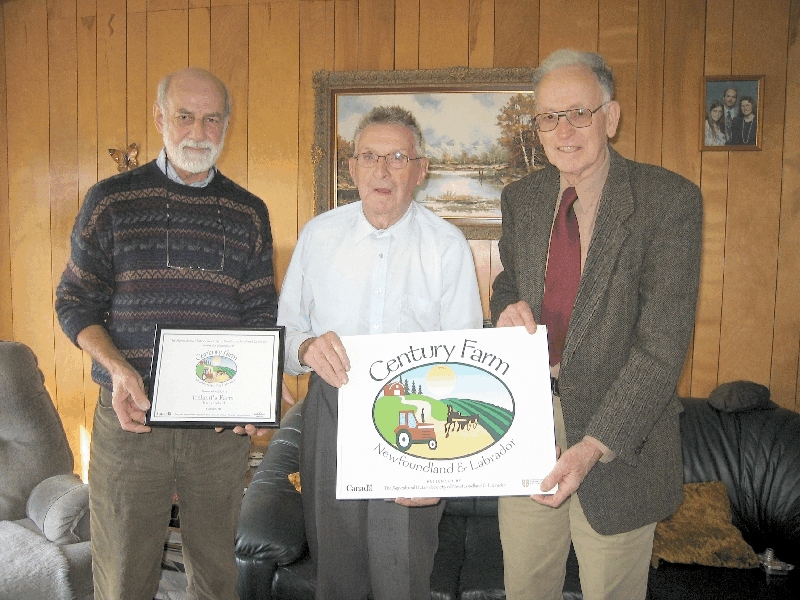


Description
NOTE: In 2005 the Agricultural History Society of Newfoundland and Labrador created the “Century Farm Award” to honour farm families across the province who had farmed their land continuously for one hundred years or more and were still actively farming. Heritage NL agreed to post these listings on our website. Please note that these farms are NOT designated by Heritage NL. The listings are commemorative only. All content and images © Agricultural History Society of Newfoundland and Labrador and used with the permission of award recipients.
Information below was current as of 2006-2007.
Ireland’s Farm
It is 2007. Mr James Ireland has been farming for seventy-seven years since he joined his father on his farm at the age of thirteen. Together, he and his father account for the full century of this Century Farm. He has seen many changes in agriculture in that time. His personal history of farming is one of coping with change and adaptation.
James’ father, William Ireland, came from England. He was a cabinetmaker who established his own furniture-making business in St John’s. However, his business was burnt to the ground in the Great Fire of 1892. And he suffered again in the Bank Crash of 1894. In 1898 he rented land in Kilbride and began farming vegetables to sell locally. Later, he purchased the land and got into the dairy business.
James, as a lad of thirteen, joined his father fulltime on the farm in 1930. He remembers that demanding daily run into town with horse and wagon to deliver milk. They had 8-10 gallons to sell.” Those who were working longshore took a pint a day and paid weekly; those who were rich took a quart a day and paid monthly.”
He remembers World War II as being good for their business. There were so many extra people in St John’s – the troops, the people who had come into town looking for jobs. And people had money. “You could sell anything you had.” And the advent of pasteurization made life much easier. No longer a daily milk round through the streets; rather, a single delivery to the plant.
William Ireland had built a house and barn on the property. Years later, James replaced these. He used local trees made into lumber, and relied on his father’s expert knowledge for construction. With two new barns holding twenty-five cows each, James had a large and thriving dairy business. And he mechanized the farm.
But by the 1970s, the situation changed again. James explains that the milk business could not provide competitive wages and workers were difficult to find. James got out of milk but kept his interest in cattle, turning his attention to raising dairy replacements.
In the late 1990s, James gave up on cattle altogether and turned his attention to growing vegetables and producing hay, both of which he sells locally.
James Ireland has no one to whom to pass on his Century Farm. However, for himself, he is looking forward to growing another vegetable crop in the spring. “I like it [growing vegetables]. It’s exercise. You get to do every part of exercise there is to be had when you are growing vegetables. You’re lifting, you’re bending, you’re stooping, you’re crawling. I suppose that is what helped me live a long life.”
The Agricultural History Society of Newfoundland and Labrador is mandated to collect and honour the history of agriculture in this province and to raise public awareness of agriculture as a theme in the story of the province. In 2005 the Society created the Century Farm Award which is meant to identify, recognize and honour any farm family who have continuously farmed the same land for one hundred years or more and who continue to farm it at the present time. This award represents the pioneering agricultural history of the province: some farms supplied the growing town of St. John’s with milk, produce, meat and forage for livery stables; other farms supplied vegetables and butter to fishing communities by coastal boat; and others sent produce and dressed poultry by rail to the new resource towns, such as Grand Falls. Some of the early farmers came directly from the British Isles and others came to Newfoundland from earlier settlements in Nova Scotia. From their early beginnings these farms have survived as productive agricultural businesses by adapting successfully to changing market demands and changing economic circumstances and by adopting innovative technology. They have kept their land in good heart through as many as half a dozen generations. The Century Farm families have earned the Century Farm Award in recognition for their contribution to the history of our province and for their commitment to agriculture in the province’s future.


