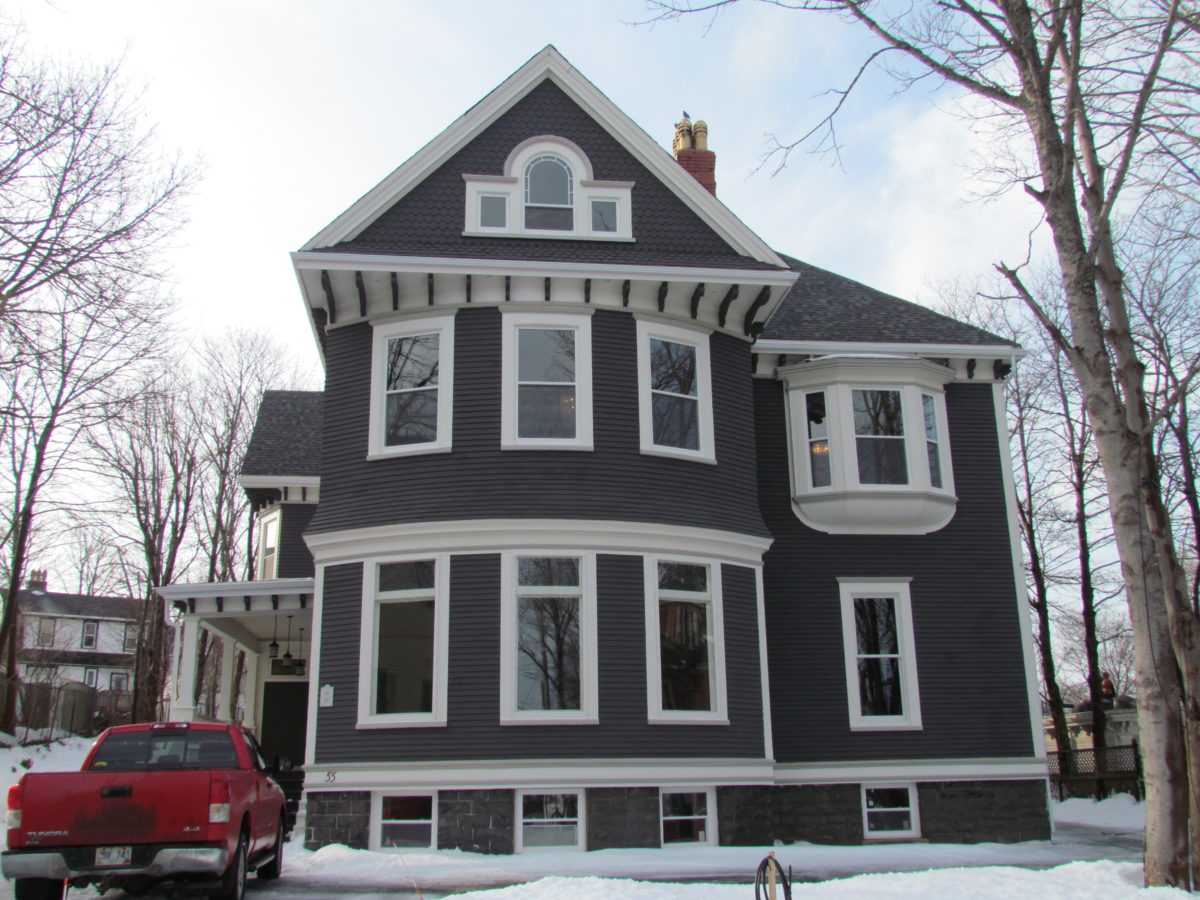
Lord Edward Patrick Morris House, built in 1898 and completed in 1900, is a wooden two-and-a-half storey Queen Anne style building with a prominent two storey bracketed rounded bay and a second storey three sided bay window. It is located at 55 Rennie’s Mill Road in St. John’s, NL. The designation is confined to the footprint of the building.
Formal Recognition Type
City of St. John's Heritage Building, Structure, Land or Area
Heritage Value
Lord Edward Patrick Morris House has been designated a heritage building by the City of St. John’s for its aesthetic and historic value.
Lord Edward Patrick Morris House has aesthetic value because of its architectural style. The asymmetrical front façade with its off-centered two storey bracketed rounded bay and left sided porch entrance and its steep roof design complete with its three sided bay window projections along the left and right facades makes the building one of St. John’s prominent Queen Anne style homes. It was designed by Architect William Frederick Butler, who also designed Winterholme, located at 79 Rennie’s Mill Road. The building is also aesthetically valuable because of its prominent location in the center of the Rennie’s Mill Road Historic District. The grand foyer showcases an original English Oak staircase with English Oak paneled walls.
Lord Edward Patrick Morris House has historic value because of its age and associations with previous occupants. Construction began in 1898 and was completed two years later. Lord Edward Patrick Morris was the first owner. The son of an Irish immigrant, Morris taught in Oderin, Placentia Bay before attending the University of Ottawa. He was admitted to the bar in 1884. The following year he was elected to the House of Assembly as an independent. He represented St. John’s West for 33 years and was particularly popular with Irish Catholic voters. He served as Attorney General (1889-1898), Minister of Justice (1900-1907) and was Newfoundland’s 12th Prime Minister (1909-1917). In 1917 Morris moved to London, was named Baron Morris and sat in the House of Lords – the only Newfoundland-born person ever appointed. In 1917, he sold the home to Eric Bowring of Bowring Brothers Limited. In 1927, it became the site of Spencer Lodge, the residence for out-of-town boarders attending Bishop Spencer School. Bishop Spencer was a private school for Church of England girls, but children of all faiths, as well as boys, were admitted. It was one of the few schools that provided scholarships for young women whose families could not afford school fees, so the pupils came from a variety of class backgrounds. The building was also home to Violet Cherrington (1886-1956). Born in England, Violet arrived in Newfoundland in 1922 to become headmistress at Bishop Spencer School. She was made a Member of the Order of the British Empire in 1938. In 1937 the house was sold to the Church of England Diocese of Newfoundland and was renamed Bishop Jones Memorial Hostel, being dedicated on February 7, 1940. It remained a hostel for girls until 1968 at which time it became a private residence once again.
Source: Designated at a regular meeting of the St. John’s Municipal Council held May 30, 2016, Council Directive #R2016-05-30/2
Character Defining Elements
All those features that reflect the Queen Anne style of architecture, including:
-Two-and-a-half storey with a steep pitched roof design;
-Asymmetrical front façade;
-Two storey prominent rounded bracketed bay topped with a gable end roof on front facade;
-Second storey prominent three sided bay window projection on front facade;
-Left sided porch veranda details;
-Two storey prominent rounded bracketed bay window projections topped with a gable end roof on left and right facades;
-Main door details, sidelights and transom;
-Location of window and door openings;
-Window and door trim details;
-Dormer window details;
-Decorative eave dentil brackets;
-Narrow wooden clapboards with wooden corner boards;
-Scalloped wooden cladding on the gable end roofs topping the bay projections on the front, left and right facades, and;
-Granite foundation walls.

 Google map
 Website