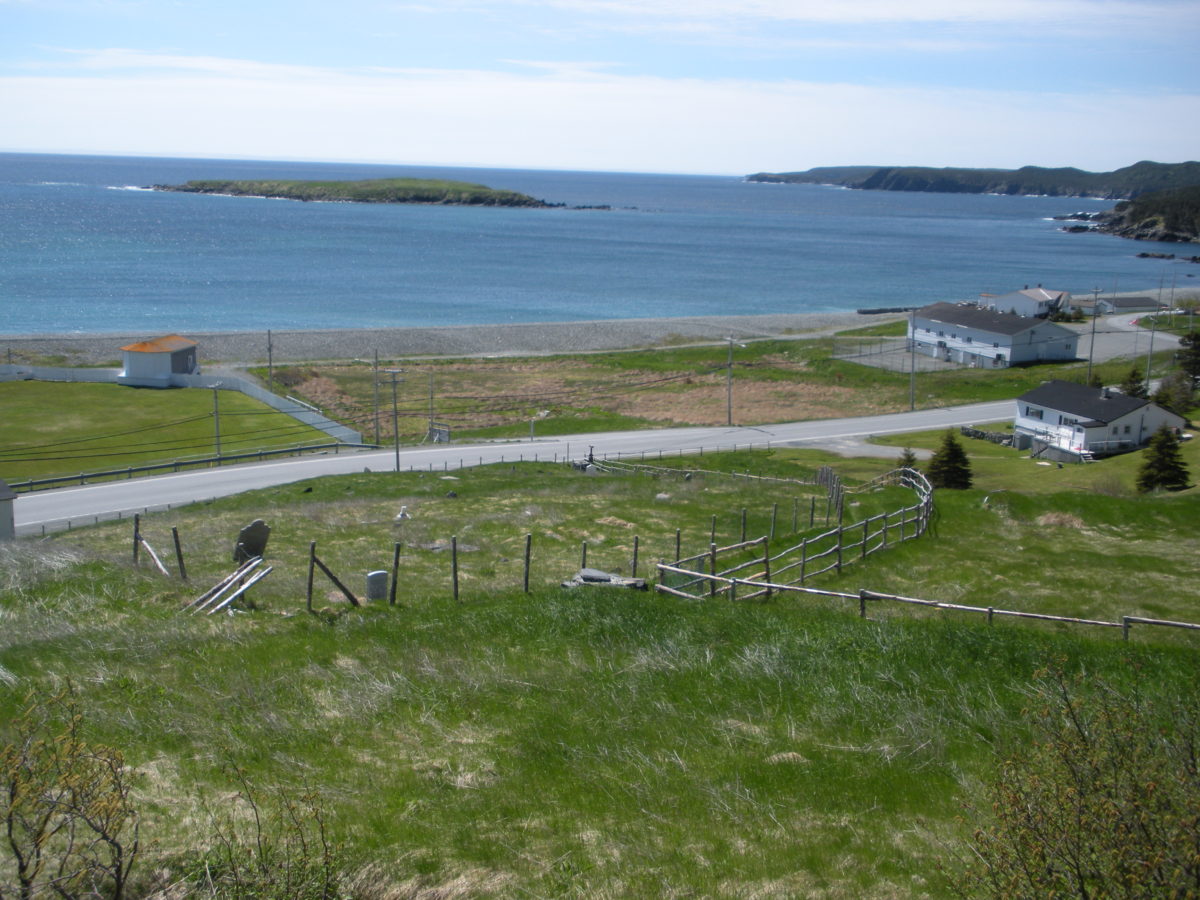
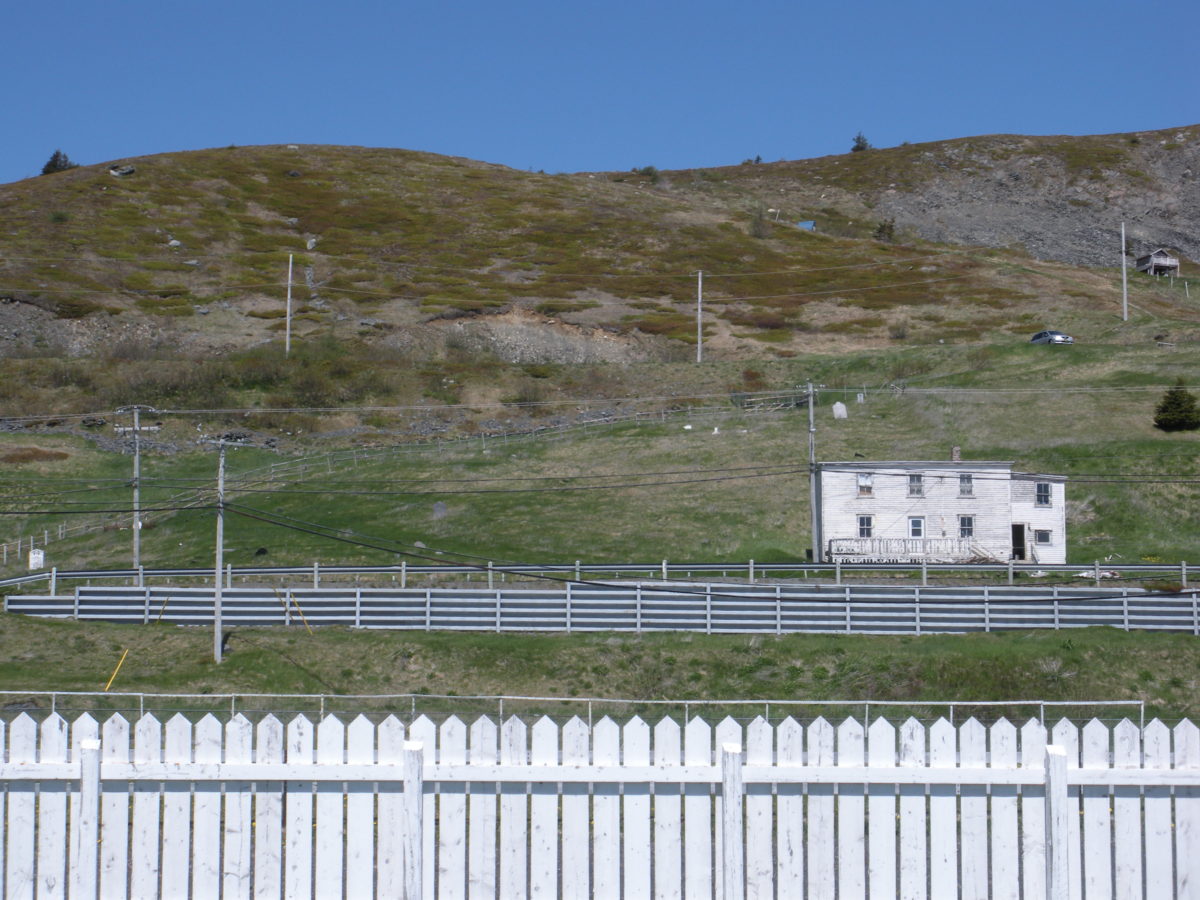
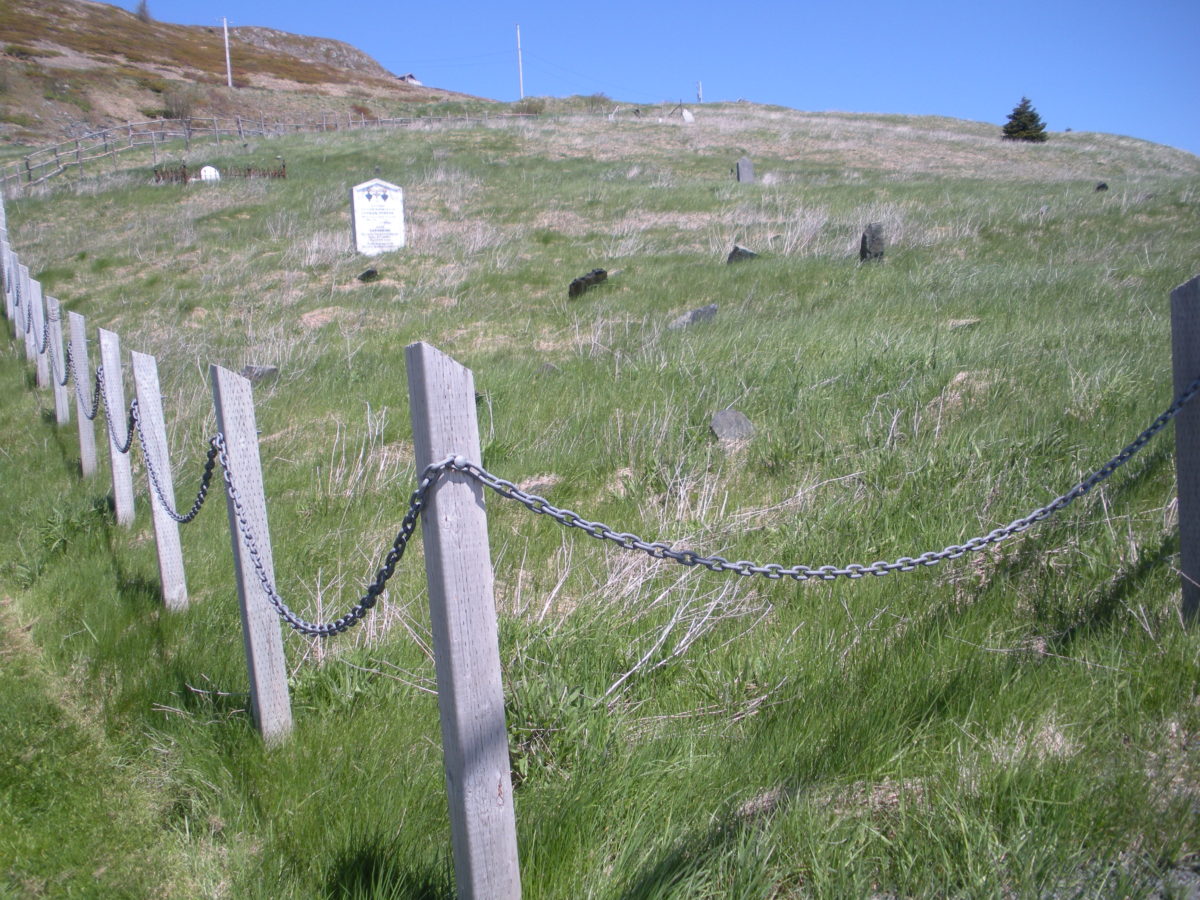
Dating to the mid-eighteenth century, South Side Burial Ground (also referred to as the General Cemetery) in Ferryland, NL served as a burial ground for almost two centuries. It is located along the Southern Shore Highway on sloping land overlooking Ferryland Harbour. The designation is confined to the area enclosed by the cemetery fence.
Formal Recognition Type
Municipal Heritage Building, Structure or Land
Heritage Value
South Side Burial Ground has been designated a municipal heritage site by the Town of Ferryland because of its historic and aesthetic value.
South Side Burial Ground has historic value as a physical record of Ferryland’s history, the cemetery markers serving as both historic records and artifacts on the landscape. There are a little over a dozen intact headstones in the cemetery, along with many smaller non-descript markers, and certainly many graves are no longer marked. It is one of the oldest known cemeteries in the community, with the earliest headstones dating from 1770. The cemetery was officially consecrated and named South Side Burial Ground in July 1827 by John Inglis, Bishop of Nova Scotia.
Although consecrated as a Protestant cemetery, it also contains the remains of some apparent Roman Catholics. Many of the extant stones contain Irish surnames, and some list places of origin in Ireland, such as Patrick and Catherine Condon from Kilkenny and William Morrissey from Tipperary. Some of those buried in South Side Burial Ground are also from neighbouring communities, such as Calvert and Cape Broyle, which were settled predominantly by Irish Catholics.
Two prominent family names in the cemetery are Morry and Carter. The Morrys first came to the region in the latter decades of the 1700s and became one of the most influential merchant families in the area. The Carter family came from England as merchants in the mid 1700s and members of the family also held many political and administrative offices throughout the 1800s. Although originally of Protestant pedigree, some Morrys and Carters did marry Roman Catholic spouses.
The most recent stone in South Side Burial Ground marks the resting place of N.C. Bennett, a crew member of the Royal Navy submarine HMS P514. The sub had left the naval base at Argentia, NL on June 20, 1942, bound for St. John’s and escorted by HMS Primrose. In the early hours of June 21, 1942, the Canadian minesweeper HMCS Georgian was waiting off Cape Race to provide escort to a convoy bound for Sydney, Nova Scotia. The night was overcast with poor visibility when the Georgian detected an approaching engine on its hydrophone. The shape of a submarine crossing its bow was spotted and, believing it to be an enemy submarine, the Georgian rammed the sub and it sank. Once the mistake was realized, a rescue mission was sent out to look for survivors. The only body recovered was that of N.C. Bennett, whose body washed ashore near the site of the collision and who was interred at South Side Burial Ground with full military honours.
South Side Burial Ground has aesthetic value due to its unique environmental setting and burial markers. Located on a small hill overlooking Ferryland Harbour, it provides an impressive view of the community, particularly the islands that dot the harbour, The Pool, The Downs, Ferryland Head and the entrance to Aquaforte Harbour. The cemetery has further aesthetic value due to the age of the remaining headstones and the materials used that correspond to the age of the cemetery.
Source: Town of Ferryland Regular Council Meeting July 1, 2008.
Character Defining Elements
All those elements which represent the historic and aesthetic value of the cemetery, including:
-extant, original memorial stones and monuments with their surviving inscriptions;
-positioning of grave markers;
-natural, grassy topography;
-view to and from the cemetery from a variety of vantage points, and;
-location, orientation and dimensions of the cemetery.
Notes
Transcript of an entry in a record book from Ferryland Parish detailing the consecration of North Side Burial Ground and South Side Burial Ground:
“Copy In the Name of God Amen! Whereas two pieces of ground, known by the names of North Side Burial Ground, and South Side Burial Ground have been provided for the decent Burial of the Dead in the settlement of Ferryland in his Majesty’s Island of Newfoundland, and in our Diocese of Nova Scotia, and whereas the Minister, Churchwardens, and principal Inhabitants of Ferryland have humbly besought us, that we would by our Authority, ordinary and Episcopal, vouchsafe to consecrate the same pieces of Ground, and set apart, and separate them from all profane and common uses and declare the same to be places of Burial for Ever, according to the Rites and Ceremonies of the united Church of England and Ireland as by Law established. Now we John, by divine permission, Bishop of Nova Scotia and its dependencies, and bearing Episcopal Authority in this Island of Newfoundland, do, by virtue of the Authority to us committed, separate the said Pieces of Ground from profane and common Uses, and do dedicate the same as places of Burial, and do openly and publickly pronounce, decree, and declare, that the same ought to remain so separated, dedicated, and consecrated for ever, by this our definitive sentence or final Decree which we read and promulge by these present. As witness our Hand the 25th day of July in the year of our Lord One thousand, eight hundred, and twenty seven. Signed John Nova Scotia”
There is some confusion on the date of consecration, as in a letter dated January 4, 1828 and written by John Inglis, Bishop of Nova Scotia, he reports that he consecrated the cemeteries in Ferryland on Sunday, July 15, 1827.

 Google map
 Website