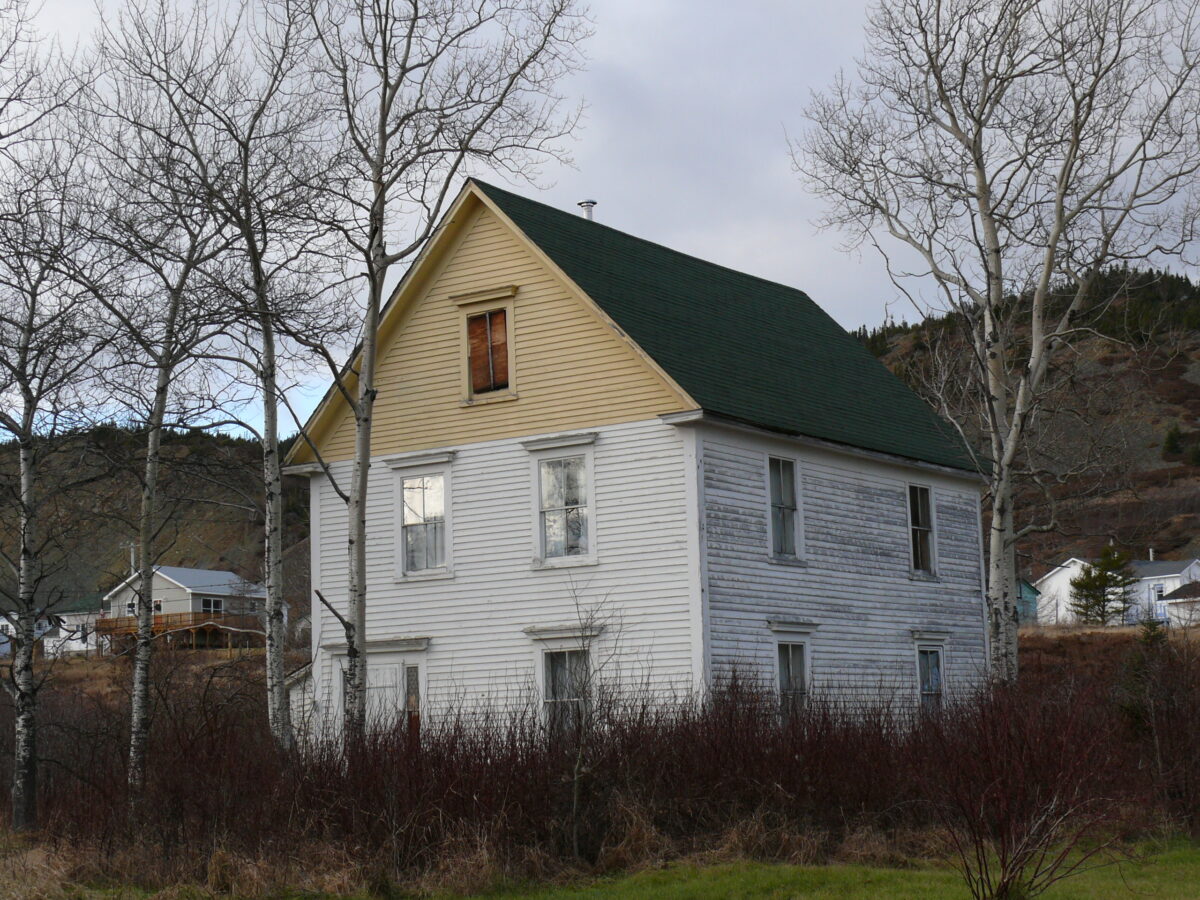
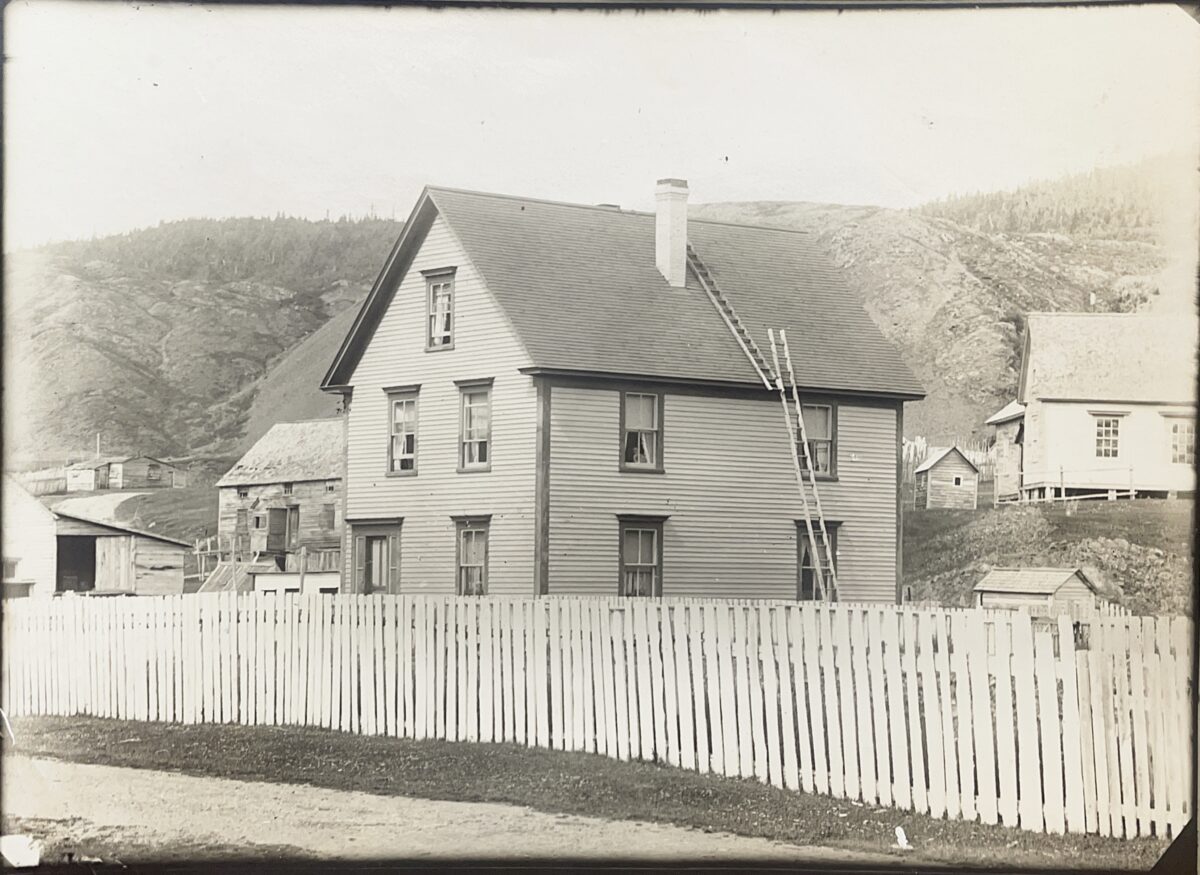
Thomas and Mary Jane Wells House is a two-and-a-half storey, wooden house with a steep gable roof. Built circa 1906, it is located in Little Bay, NL. The designation is confined to the footprint of the building.
Formal Recognition Type
Registered Heritage Structure
Heritage Value
Thomas and Mary Jane Wells House was designated a Registered Heritage Structure by the Heritage Foundation of Newfoundland and Labrador in 2025 due to its historic and aesthetic value.
Thomas and Mary Jane Wells House has historic value due to its association with Thomas E. Wells, who served as a policeman, magistrate and relieving officer in Little Bay, Notre Dame Bay. Originally from Salmon Cove in Conception Bay, Thomas E. Wells was one of the original recruits to the Newfoundland Constabulary, which was founded in 1871. After serving a little over ten years in Twillingate, Thomas was posted to Little Bay in 1883. Little Bay was the site of a large copper deposit and in the late 1870s a mine was opened in the community. The population grew quickly and by the time of Sergeant Wells’ arrival the population was approximately 1600. Less than ten years later this had grown to 2100.
With the influx of prospectors, miners, construction workers and businesses, Little Bay had quickly become one of the larger communities in Newfoundland. With prosperity came many other problems, as documented in diaries kept by Sergeant Wells. Drinking appears to have been at the root of many of these problems, and Sergeant Wells, who was a member of the Sons of Temperance, tried to quell the sale of alcohol in the many unlicensed shebeens in the community. Thomas was a policeman in the community from 1883-1898, a magistrate from 1906-1920, and a relieving officer from 1900-1930. He also was involved in the mining industry from the time of his arrival in Little Bay to his death. He held many mining stakes in central Newfoundland and was very interested in finding areas for potential new mines, although the ventures were only ever modestly successful.
Thomas most likely met Mary Jane, whose maiden name was also Wells, when he was stationed in Twillingate. The couple was married there in January of 1876. They would have 12 children together, two who died when they were toddlers. Many of their children settled in Canada and the United States and both Thomas and Mary Jane travelled often to visit them. The house they built in Little Bay would be home to three generations of their family – at times members of all three generations lived there together. Mary Jane passed away in 1923 at the age of 65 and Thomas died in 1935 in his 89th year. Their daughter Fannie and son Gus would also live in the home, which was later owned by Gus’s daughter Joan. The house was acquired by the Little Bay Heritage Society in 2025.
Thomas and Mary Jane Wells House has aesthetic value as a fine example of early 20th century vernacular architecture. The steeply gabled roof and window style are typical of this period. However, the design of the house shows a break from the traditional three bay main façade with a central entry. The main door of this house is on the shorter gable end and the longer façade is divided into two bays rather than three. The plain adornment of the house is in keeping with many outport homes of the time, but its size is indicative of the fact that it was constructed by a well-to-do member of the community.
Source: Heritage Foundation of Newfoundland and Labrador property file “Little Bay (Notre Dame Bay) – Thomas and Mary Jane Wells House – FPT 5017”
Character Defining Elements
All those elements which represent the aesthetic value of Thomas and Mary Jane Wells House, including:
– number of storeys;
– steeply pitched gable roof;
– return on eaves;
– chimney style and placement;
– size, style and location of additions;
– narrow wooden clapboard;
– corner boards;
– wooden window size, style, trim and placement;
– size, style, trim and placement of exterior wooden doors;
– entablatures over windows and doors;
– sidelights on main door, and;
– dimension, location and orientation of building.
 Google map